ASV
ASV VT-80-1C

The bright segment is what ASV VT-80-1C is rated to carry; the grey run past it is the rest of its tipping load. Bar length is tipping load drawn to the same scale on every machine on the site, so a short bar is a smaller machine and not a conservative rating.
The ASV VT-80-1C is the brand's big mid-frame vertical-lift Posi-Track loader, stacking a 2,800 lb rated capacity and 34.3 GPM optional high flow onto the suspended undercarriage ASV is known for. It squares up against the Kubota SVL75 and Bobcat T76 class while out-floating them all on soft ground.
Also sold as
The same machine is sold as the Yanmar TL80VP — different paint, different dealer network, same hardware, so the choice is usually about which dealer is closer and which one you would rather owe a service call to.
Suits: Serious lift capacity and attachment flow without giving up Posi-Track flotation and ride Its vertical lift path reaches highest at full extension, for loading high-sided trucks and stacking.
Lifting and reach
- Rated operating capacityTrack loader rating convention
- 2,800 lbs
- Tipping load
- 8,000 lbs
- Lift height to hinge pin
- 126.5 in
- Lift path
- Vertical Lift
- Operating weight
- 8,955 lbs
Power and hydraulics
- Engine power
- 72 hp
- Engine
- Yanmar 4TN86CHT
- Auxiliary flowStandard circuit
- 24.7 GPM
- Flow type
- Standard
- Warranty
- 2 yr / 2,000 hr
Fitted or available
What this machine can be ordered with. Some of these are standard and some cost extra, and which is which moves between trim levels, so check them against the quote rather than against this list.
What owners report
Summarised from the sources listed below. Nothing here was tested by us.
Somewhere between the mid-frame and large-frame classes sits the model where ASV stops apologising for its capacity chart. 2,800 lbs at 35% of tipping load, an optional 34.3 gpm high-flow circuit and 3.9 psi of ground pressure is an unusual combination - normally a machine that floats that well lifts less than its rivals, and this one does not.
The undercarriage is the reason to be here. Torsion axles suspend the whole track frame from the chassis and the bogie wheels flex on top of that, so ground shock is damped twice before it reaches the operator or the attachment. Owners describe the consequence in practical terms: the machine is driveable at its 9.1 mph top speed across ground where a rigid-undercarriage CTL of the same weight has to slow to keep material in the bucket. The pressurised MAX-Series cab is a real generational change from older ASVs, with a colour touch display and proper glass area. The bill arrives underneath. There are far more wheels, bearings and seals down there than on a conventional undercarriage, the open rails want washing out rather than trusting to self-cleaning, and a track set costs more than a rival's.
It comes into its own on soft, wet or finished ground where you need both lift capacity and enough hydraulic flow to run a serious attachment - land clearing, brush work, site prep, snow. If you work rock or demolition, the flotation is wasted and the track bill is not. Before you sign, check the flow rating of the attachment you actually intend to run against the 24.7 gpm standard and 34.3 gpm optional circuits, price the undercarriage parts list in writing, and find out how far the nearest ASV parts counter is - that distance is the most common regret owners of this brand report.
What owners like
- A 34.3 gpm high-flow option on a mid-frame machine is more circuit than most rivals of this size offer, and it moves the machine into mulching-head and snow-blower territory without stepping up a frame size.
- 2,800 lbs rated at 35% of tipping load is a genuinely competitive number for ASV, which historically traded capacity away for flotation - this is the model where it stops giving ground on the spec sheet.
- 3.9 psi ground pressure from a machine near 9,000 lbs is the Posi-Track payoff: the all-rubber tracks lay down several times the ground contact points of a steel-embedded belt, so weight spreads instead of digging in.
- Dual-level suspension - torsion axles hanging the undercarriage, flexing bogie wheels underneath - is what lets it hold 9.1 mph across rough ground rather than forcing the operator to slow down to keep the bucket loaded.
- The pressurised MAX-Series cab keeps dust out on demolition cleanup and dry-site work, with a 7-inch colour touch display and 360-degree glass rather than the narrow letterbox view older ASVs had.
- Return-to-dig and a work-tool positioner are the kind of repeatability features that save real minutes on a day of truck loading, and they are on the machine rather than on the options sheet at this size.
What owners complain about
- Undercarriage parts are where ASV ownership costs money. A track set is roughly $4,000-$6,000 against $3,500-$5,500 for comparable steel-embedded belts, and there are many more wheels, bearings and seals to service underneath.
- The all-rubber poly-cord tracks that buy the flotation are the wrong tracks for rock, rebar and demolition debris - mixed-surface contractors pay for that in shortened track life.
- About 200 ASV dealer locations against Cat's 600-plus is the structural problem with the brand, and owners' standing advice is to confirm a parts counter within an hour before buying.
- Resale sits around 60-65% at three years where a comparable Cat holds 70-75%, which claws back part of the price advantage at trade-in.
- At 71.5 hp it gives away real power to the 90-110 hp machines buyers cross-shop for heavy mulching, so the high-flow circuit can outrun the engine on the hungriest attachments.
Drawn from asvi.com, ownrops.com, compactequip.com.
What buyers ask
Is the high-flow option worth it on the VT-80-1C?
How does 2,800 lbs compare to rivals on the same basis?
What makes the Posi-Track undercarriage different from a Cat or Bobcat undercarriage?
What does the undercarriage cost to maintain?
Does the pressurised cab come standard?
Put the ASV VT-80-1C against
Machines in the same range
The rest of the ASV line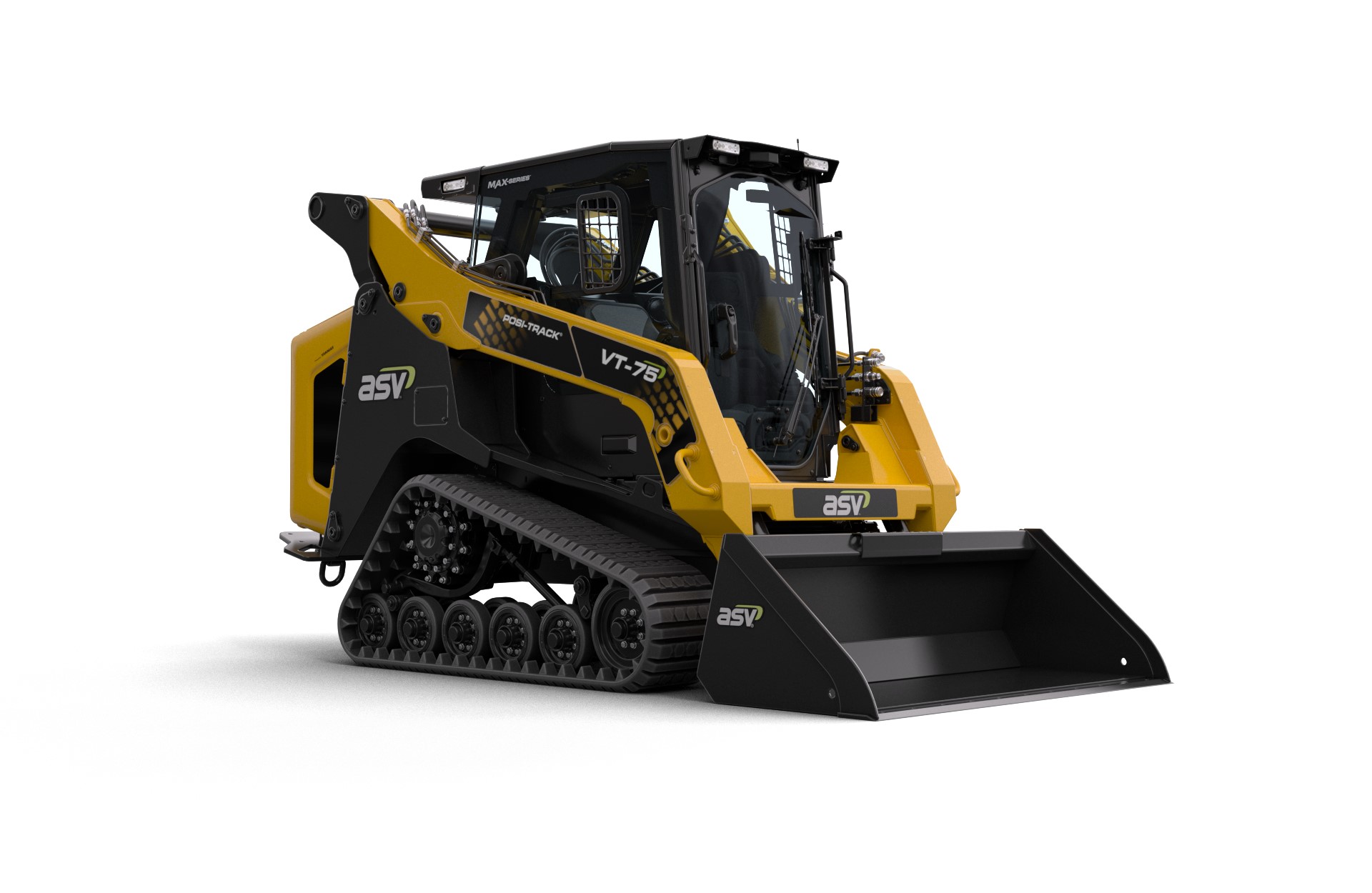
ASV
ASV VT-75-1C
$73,000
Also sold as the Yanmar TL75VP
- Engine
- 72 hp
- Aux flow
- 21.4 GPM
- Weight
- 7,915 lbs
The ASV VT-75-1C is a mid-frame vertical-lift Posi-Track loader that succeeds the long-running RT-75, pairing a 71.5 hp Yanmar turbo-diesel with a 2,300 lb rated capacity and a 10.5-foot lift height. It brings ASV's suspended undercarriage and flotation to operators who need to load over dump truck sides.
Full sheet & owner reports
ASV
ASV VT-100
$98,000
Also sold as the Yanmar TL100VP
- Engine
- 104 hp
- Aux flow
- 23 GPM
- Weight
- 10,835 lbs
The ASV VT-100 is the brand's large-frame vertical-lift Posi-Track loader, combining a 103.5 hp Yanmar turbo-diesel, 3,500 lb rated capacity, and 41 GPM high flow with the redesigned MAX-Series cab. It's the truck-loading, attachment-running flagship of ASV's vertical-lift line.
Full sheet & owner reports
ASV
ASV RT-65-1C
$61,000
Also sold as the Yanmar TL65RP
- Engine
- 67 hp
- Aux flow
- 21.4 GPM
- Weight
- 7,405 lbs
The ASV RT-65-1C is a mid-frame radial-lift Posi-Track loader with a 67.1 hp Yanmar turbo-diesel, a 2,000 lb rated capacity, and the brand's suspended rubber-track undercarriage. It's the volume seller in ASV's range - sized and priced against the Bobcat T595-class machines but built for mud, snow, and soft ground where they struggle.
Full sheet & owner reports