ASV
ASV RT-135

The bright segment is what ASV RT-135 is rated to carry; the grey run past it is the rest of its tipping load. Bar length is tipping load drawn to the same scale on every machine on the site, so a short bar is a smaller machine and not a conservative rating.
The ASV RT-135 is the most powerful Posi-Track loader ASV builds - a 132 hp Cummins turbo-diesel, up to 50 GPM of high flow, and a 12,000 lb frame designed to run mulching heads all day. It's a purpose-built attachment powerhouse more than a bucket machine.
Suits: Vegetation management and land clearing with mulchers and high-flow attachments running full time Its radial lift path reaches furthest at mid-height, for digging, grading and backfilling.
Lifting and reach
- Rated operating capacityTrack loader rating convention
- 3,500 lbs
- Tipping load
- 10,000 lbs
- Lift height to hinge pin
- 125 in
- Lift path
- Radial Lift
- Operating weight
- 12,075 lbs
Power and hydraulics
- Engine power
- 132 hp
- Engine
- Cummins QSF3.8
- Auxiliary flowStandard circuit
- 20 GPM
- Flow type
- Standard
- Warranty
- 2 yr / 2,000 hr
Fitted or available
What this machine can be ordered with. Some of these are standard and some cost extra, and which is which moves between trim levels, so check them against the quote rather than against this list.
What owners report
Summarised from the sources listed below. Nothing here was tested by us.
Flotation and hydraulic capacity are what this machine sells, and it sells them harder than anything else in the class. The Cummins QSF3.8 makes 132 hp and 360 lb-ft, the high-flow circuit runs to 50 GPM off an oversized 66 GPM pump so an attachment keeps working while the machine moves, and 12,075 lb spread over the suspended Posi-Track undercarriage comes out at 4.7 psi with 15 in of ground clearance. Land clearing and vegetation management crews are the intended buyers and the design reflects it everywhere.
The undercarriage is the whole argument. Two independent torsion axles per side, redesigned 20 percent stronger than the RT-120's, carry 24 polyurethane-and-rubber wheels per track on a flexible band driven by an internal sprocket - which is why ASV can offer a no-derailment guarantee alongside the 2-year, 2,000-hour warranty. The rest of the machine is built to keep debris out rather than to be dug out afterwards: sealed fuse panels, foam-blocked openings, a fuel tank that seals against the cab, tilting belly pans and a swing-out cooling package. The cost of all those contact points is that they are all things to inspect and eventually replace, and undercarriage work on a 12,000 lb machine is expensive.
Right for crews who mulch, clear and push on soft ground full time and wrong for anyone whose main job is loading trucks - the vertical-lift VT-100 carries the same 3,500 lb for about $34,000 less, and the premium here buys engine and flow rather than capacity. Two things to settle before signing: confirm the machine actually has the high-flow package, because at 20 GPM standard it cannot feed the attachments that justify it, and decide whether you want this or the separate RT-135 Forestry, which is a heavier machine with higher capacity and genuine forestry guarding.
What owners like
- 132 hp and 360 lb-ft from the Cummins QSF3.8, feeding a high-flow circuit of 50 GPM that is fed in turn by an oversized 66 GPM auxiliary pump. The oversizing is the part that matters: there is reserve oil held back so a mulching head keeps turning at full speed while you are also driving the machine, rather than the head bogging every time you move.
- Flotation is the real argument for this platform. 12,075 lb spread across 18 in tracks works out to 4.7 psi, and the suspended undercarriage carries the machine on two independent torsion axles per side with 24 polyurethane-and-rubber wheels per track rather than a handful of steel rollers. On slash, soft forest floor and wet ground it floats where a steel-track machine trenches.
- 15 in of ground clearance, which is extraordinary for a compact track loader and exactly what you want driving over stumps and slash rather than dragging a belly pan across them.
- Its 3,500 lb rating is quoted at 35 percent of a 10,000 lb tipping load - the conservative convention most of the industry uses for track loaders. Unlike the New Holland and Case machines that headline at 50 percent, this number needs no adjustment before comparison, and the underlying stability is genuinely there.
- ASV backs the undercarriage with a 2-year, 2,000-hour warranty that includes a no-derailment guarantee, which is a meaningful commitment given that the flexible track and internal positive drive sprocket are the whole basis of the design.
- Built to keep debris out rather than merely to be cleaned afterwards: heavy-gauge steel hood, foam seals over exposed areas, sealed fuse panels, and a fuel tank that intersects the cab for a tighter seal. Tilting belly pans, a swing-out cooling package and a hinge-up air conditioning condenser make the daily clean-down quick.
- A roof escape hatch is standard, which ASV is alone in fitting to compact track loaders and which matters on a machine that works under standing timber.
What owners complain about
- The 20 GPM standard auxiliary circuit is low for a machine of this size and price, so in practice this loader only makes sense with the high-flow package. A base-spec machine is not the loader the launch coverage describes, and a used one without high flow is a 132 hp carrier you cannot feed.
- At roughly $132,000 it costs about $34,000 more than ASV's own VT-100, which carries an identical 3,500 lb rating. The money buys engine and hydraulics, not lift capacity - 132 hp against 104, and 12,075 lb of machine against 10,835. Be clear that is the trade you are making, because on the spec line that matters to a truck-loading buyer the two are the same machine.
- Radial lift with 125 in to the bucket pin makes it a poor truck loader for its size. The VT-100 is the vertical-lift machine in ASV's range; this one is shaped for pushing, clearing and mulching.
- Many wheels and bearings per track is what buys the flotation, and it is also what you maintain. Debris-heavy work means constant attention to the undercarriage, and a rebuild on a 12,000 lb machine is not a cheap afternoon.
- This is the base RT-135, not the RT-135 Forestry, and the difference is substantial: the Forestry model rates 4,150 lb on an 11,858 lb tipping load, weighs 12,990 lb, and adds the 3/4-in polycarbonate frameless door, 1/2-in side panels, limb riser and level 2 guarding. Most of the press attention this machine attracts is about that variant. If you are buying for forestry, buy the Forestry.
- Owner reporting on this machine is genuinely scarce, which is its own risk at this money. One operator running a 2024 Bobcat T86 forestry machine he was very displeased with went looking for anyone with comparative experience of the RT-135 Forestry or VT-100 Forestry, and got no answer at all. You will struggle to find another owner to ask before you commit.
- ASV's dealer network is thin, and this is a flagship that by design works a long way from town. Fuel burn under continuous mulching load is serious too - the machine carries a 52-gallon tank for a reason.
Drawn from asvi.com, earthmovers-magazine.com.au, skidsteerforum.com, aglist.ca.
What buyers ask
What is the difference between the RT-135 and the RT-135 Forestry?
Why buy this over ASV's own VT-100 when both are rated at 3,500 lb?
Do I need the high-flow package?
Is the rated capacity comparable across brands?
How much undercarriage maintenance does the Posi-Track system need?
What should I be cautious about before committing to one?
Put the ASV RT-135 against
Machines in the same range
The rest of the ASV line
ASV
ASV VT-100
$98,000
Also sold as the Yanmar TL100VP
- Engine
- 104 hp
- Aux flow
- 23 GPM
- Weight
- 10,835 lbs
The ASV VT-100 is the brand's large-frame vertical-lift Posi-Track loader, combining a 103.5 hp Yanmar turbo-diesel, 3,500 lb rated capacity, and 41 GPM high flow with the redesigned MAX-Series cab. It's the truck-loading, attachment-running flagship of ASV's vertical-lift line.
Full sheet & owner reports
ASV
ASV VT-80-1C
$82,000
Also sold as the Yanmar TL80VP
- Engine
- 72 hp
- Aux flow
- 24.7 GPM
- Weight
- 8,955 lbs
The ASV VT-80-1C is the brand's big mid-frame vertical-lift Posi-Track loader, stacking a 2,800 lb rated capacity and 34.3 GPM optional high flow onto the suspended undercarriage ASV is known for. It squares up against the Kubota SVL75 and Bobcat T76 class while out-floating them all on soft ground.
Full sheet & owner reports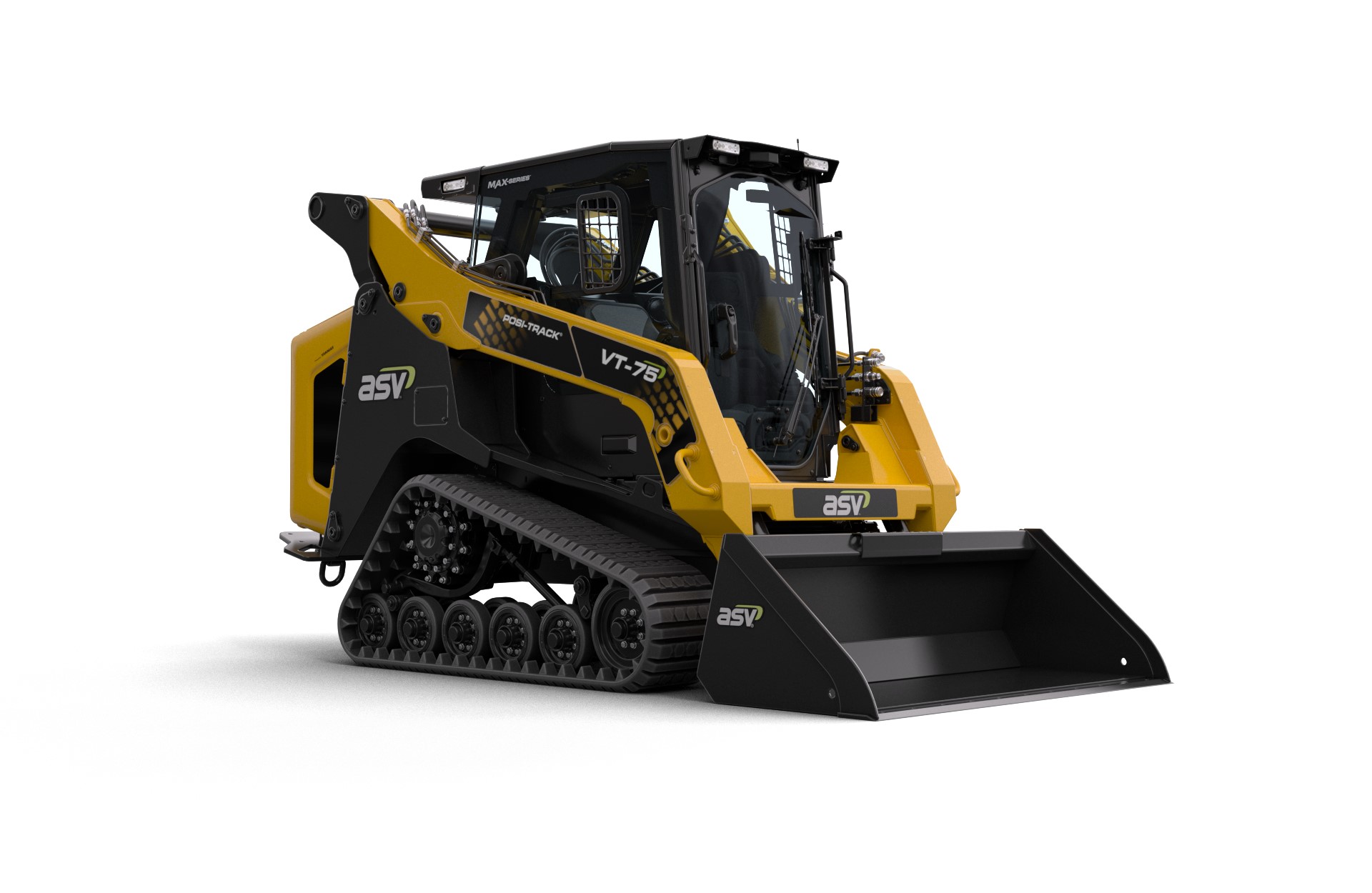
ASV
ASV VT-75-1C
$73,000
Also sold as the Yanmar TL75VP
- Engine
- 72 hp
- Aux flow
- 21.4 GPM
- Weight
- 7,915 lbs
The ASV VT-75-1C is a mid-frame vertical-lift Posi-Track loader that succeeds the long-running RT-75, pairing a 71.5 hp Yanmar turbo-diesel with a 2,300 lb rated capacity and a 10.5-foot lift height. It brings ASV's suspended undercarriage and flotation to operators who need to load over dump truck sides.
Full sheet & owner reports