Head to head
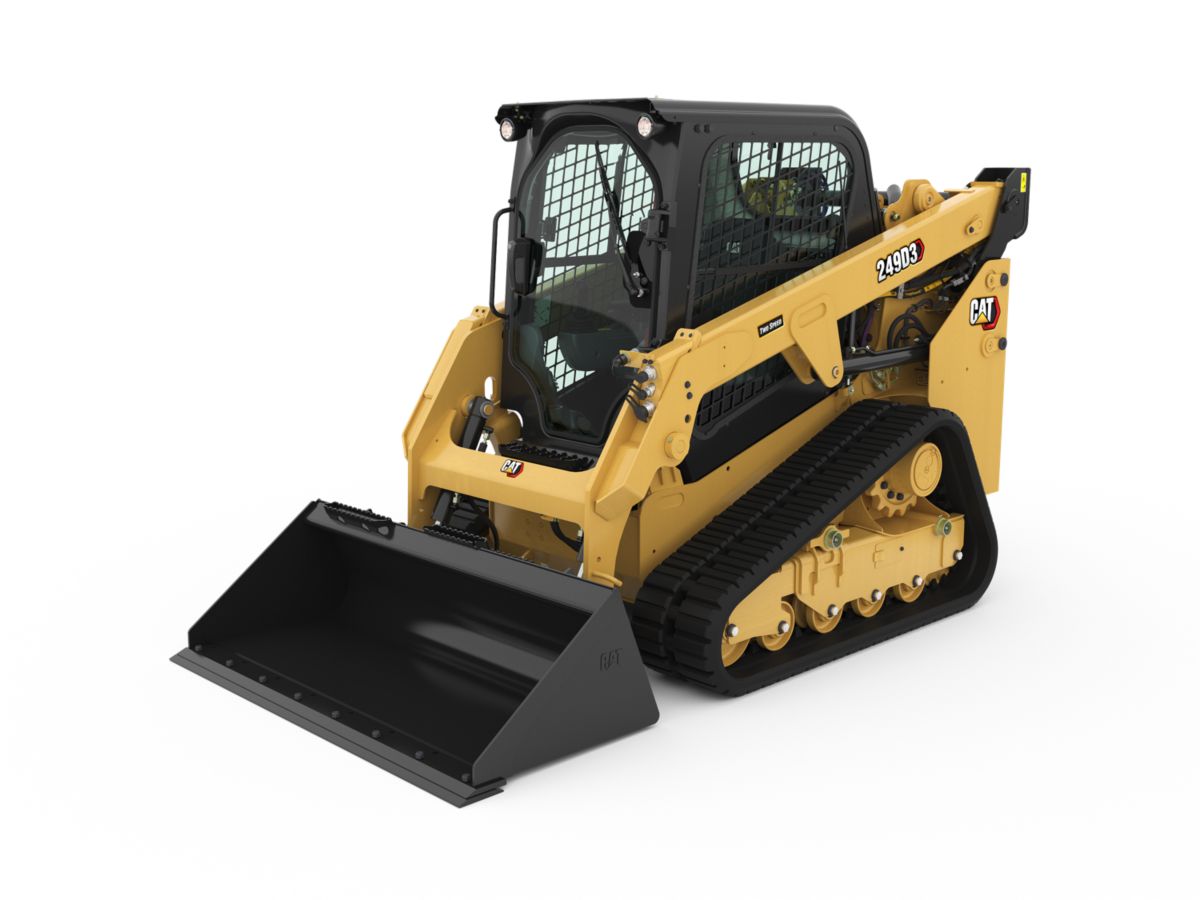
New Holland C327 against Cat 249D3
The Cat 249D3 saves $608; the New Holland C327 carries 150 lb more once both are rated the same way; the New Holland C327 moves 6.2 GPM more through the auxiliary circuit.

| Spec | New Holland C327 | Cat 249D3 |
|---|---|---|
| Price | $60,000 | $59,392 |
| Rated capacity, as advertised | 2,700 lbs | 1,740 lbs |
| Rated at | 50% of tipping load | 35% of tipping load |
| Tipping load | 5,400 lbs | 4,970 lbs |
| Capacity at its class convention | 1,890 lbs | 1,740 lbs |
| Engine power | 74 hp | 67 hp |
| Engine | FPT | Cat C2.2 CRDI |
| Auxiliary flow | 24.2 GPM | 18 GPM |
| Lift height | 123 in | 118.2 in |
| Operating weight | 8,270 lbs | 7,831 lbs |
| Lift path | Radial Lift | Vertical Lift |
| Rubber tracks | Yes | Yes |
| High flow available | Yes | Yes |
| Enclosed cab available | Yes | Yes |
| Two-speed travel available | Yes | Yes |
| Self-levelling available | Yes | Yes |
| A/C and heat available | Yes | Yes |
| Warranty | 2 yr / 2,000 hr | 2 yr / 2,000 hr |
What owners say about each
New Holland C327
- The 74 hp FPT engine and 8270 lb weight give it a strong power-to-weight feel for grading and pushing dirt.
- A 32.4 GPM high-flow option lets it run brush cutters and mulchers that many radial CTLs in this class can't feed.
- Track drive keeps it working in mud and on slopes where the wheeled 300 Series machines would spin out.
- The wide 300 Series cab, 8-inch display, and standard backup camera carry over from the pricier models unchanged.
- It's priced below the Case TR270B-class competition, making it one of the cheaper 74 hp CTLs from a major brand.
- Shared CNH platform parts with Case track loaders make sourcing wear items easier than the NH dealer count implies.
- The 98-inch dump height and modest reach make loading tall trucks awkward - buyers who load daily should step to the vertical-lift C-Series machines.
- Radial geometry arcs the load back over the machine as it lifts, limiting placement precision at full height.
- Track undercarriage maintenance costs are real - rollers, idlers, and rubber tracks add up fast versus a wheeled machine.
- At 8270 lbs it's heavier than several competing radial CTLs, which matters for trailering behind a 3/4-ton truck.
- Owners report FPT emissions sensors can throw nuisance codes that are annoying to diagnose without a nearby dealer.
- As the only radial CTL in the lineup it gets less marketing attention, and some dealers stock few units to demo or rent.
Cat 249D3
- Vertical lift on the smallest Cat CTL frame means it loads trucks cleanly, which the radial 239D3 beside it does not.
- At 7,831 lb it is the lightest track loader Cat sells, so it moves on a 10k trailer and crosses turf that a heavier machine would rut.
- The sub-75 hp C2.2 CRDI skips DEF and SCR entirely, cutting a consumable and a set of sensors out of the ownership story.
- Cat publishes a $59,392 starting MSRP, so the smallest CTL in the line is also the one with the clearest published price.
- Its 1,740 lb headline is the conservative 35%-of-tipping rating, so it compares like-for-like against Bobcat, Deere and Kubota without adjustment.
- 1,740 lb is the smallest rated capacity in Cat's CTL line, and buyers moving pallets rather than mulch generally end up wanting the 255.
- 18 GPM standard flow puts mulchers and large planers out of reach unless the 26 GPM high-flow option is specified.
- It stays on the D3 platform while everything from the 255 up is next-gen, so the newer displays, telematics and torque are not available at this size.
- Undercarriage consumables cost more than tyres on any CTL, and Cat's parts pricing sits at the top of the market.