ASV
ASV RT-25

The bright segment is what ASV RT-25 is rated to carry; the grey run past it is the rest of its tipping load. Bar length is tipping load drawn to the same scale on every machine on the site, so a short bar is a smaller machine and not a conservative rating.
48 inches wide and 3,755 lbs, the ASV RT-25 is the smallest sit-in compact track loader on the market - a Posi-Track machine that fits through a standard backyard gate. It gives fencing crews, landscapers, and rental fleets a real cab-and-joysticks loader where only walk-behinds used to fit.
Suits: Backyard and tight-access work through 48-inch gates where walk-behind loaders were the only option Its radial lift path reaches furthest at mid-height, for digging, grading and backfilling.
Lifting and reach
- Rated operating capacityTrack loader rating convention
- 665 lbs
- Tipping load
- 1,900 lbs
- Lift height to hinge pin
- 101 in
- Lift path
- Radial Lift
- Operating weight
- 3,755 lbs
Power and hydraulics
- Engine power
- 25 hp
- Engine
- Perkins 403J-17T
- Auxiliary flowStandard circuit
- 11.3 GPM
- Flow type
- Standard
- Warranty
- 2 yr / 2,000 hr
Fitted or available
What this machine can be ordered with. Some of these are standard and some cost extra, and which is which moves between trim levels, so check them against the quote rather than against this list.
What owners report
Summarised from the sources listed below. Nothing here was tested by us.
Nothing else with a seat and a roof fits through a garden gate, and that single dimension is the entire buying case. At 48 inches wide and 3,755 lbs it slots into a gap between stand-on mini loaders and the smallest conventional track loaders, and the people who own one bought it because the alternative on back-yard work was a wheelbarrow and a crew.
The undercarriage is the good part: 3.1 psi over 1,210 square inches, twelve polyurethane roller wheels per track, and the suspended ASV design that rides and climbs better than the rigid frames used on mini loaders. The 24.7 hp Perkins sits under the 25 hp emissions threshold on purpose, so there is no diesel particulate filter, no regeneration and no exhaust fluid - the simplest driveline in the catalog. Against that, 665 lbs of rated capacity and an 11.3 gpm auxiliary circuit at 3,000 psi define a narrow job list, and the single-speed 5.1 mph drive makes ground moves slow enough to notice.
As a second machine for a landscaper or a fenced-yard specialist it makes sense, or a rental-fleet unit where an enclosed cab beats a stand-on for first-time renters. It is not a first skid steer. Before signing, confirm which capacity figure the quote is using, confirm whether the heated cab and suspension seat are on the order, and measure the gates you actually work through - if they are five feet, a Bobcat T450 or Takeuchi TL6R gives far more machine for the money.
What owners like
- Forty-eight inches wide is the whole product. Every other sit-in track loader in the small class starts wider - Bobcat's T450 at 55 inches, Wacker Neuson's ST27 at 60, Takeuchi's TL6R at just over five feet - so this is the only one with a cab and a ROPS that clears a standard four-foot residential gate. Owners buying it are buying access to the back yard, not lifting power.
- Ground pressure is 3.1 psi over 1,210 square inches of track contact, carried on twelve 10-inch polyurethane roller wheels per side. That is the ASV suspended undercarriage rather than a rigid roller frame, and it is why the machine crosses finished turf, irrigation lines and golf greens leaving marks a rake fixes.
- The Perkins 403J-17T is rated 24.7 hp, deliberately under the 25 hp line, so it meets Tier 4 Final with no regeneration cycle, no exhaust sensors and no diesel exhaust fluid. The pumps are direct drive with no belts to service. On a machine this small, the aftertreatment you do not have is the failure you do not get.
- A 101-inch lift height is disproportionate to the size and is what separates it from a stand-on loader - it genuinely puts a bucket over the side of a landscape dump trailer instead of merely shuttling material to one.
- Rental yards favour it for first-time operators, because an enclosed ROPS cab with a seat belt is a different risk proposition from handing someone a stand-on machine, and its 3,755 lb operating weight tows behind a half-ton.
What owners complain about
- Rated operating capacity is 665 lbs against a 1,900 lb tipping load. A pallet of sod, a cube of wet retaining-wall block or a full bucket of saturated clay is over the limit before the boom leaves the ground.
- ASV publishes two capacity figures on the same spec sheet - 665 lbs at 35 percent of tipping load and 950 lbs at 50 percent - and the 950 lb number turns up in dealer listings and classifieds. It is the same machine measured with less reserve held back, so never carry a 50 percent figure into a comparison against a rival's 35 percent one.
- Auxiliary flow is 11.3 gpm at 3,000 psi and there is no high-flow option at any price. An auger or a small trencher works; a mulching head, a cold planer or a snow blower does not, and no dealer can add the capability later.
- That 3,000 psi system pressure is itself a limit separate from the flow - most full-size loaders run 3,300 to 4,000 psi, so an attachment specified against a normal skid steer circuit will not make its rated performance here.
- Travel is 5.1 mph with no two-speed. Any move longer than one side of a property is walked, and on a job spread over several lots that adds up to real hours.
- The base machine is a ROPS with a basic seat and a lap belt - the suspension seat and the heated cab are options. Buyers comparing quotes should check which they are being shown, because a machine bought for winter sidewalk work without the heat package is a miserable purchase.
- Cost per pound of capacity is the worst in the catalog by a wide margin. Anyone who does not specifically need the 48-inch width gets three to four times the lifting machine for the same money.
Drawn from asvi.com, constructionequipmentguide.com, compactequip.com.
What buyers ask
Will the RT-25 really fit through a standard backyard gate?
Why does one listing say 665 lbs and another says 950 lbs?
Can it run a mulcher or a cold planer?
What can I tow it with?
Does it need diesel exhaust fluid or run regeneration cycles?
Is it worth buying rather than renting?
Put the ASV RT-25 against
Machines in the same range
The rest of the ASV line
ASV
ASV RT-50
$47,000
Also sold as the Yanmar TL50RP
- Engine
- 54 hp
- Aux flow
- 13.3 GPM
- Weight
- 5,180 lbs
Towable behind a half-ton pickup at just 5,180 lbs, the ASV RT-50 packs a 1,400 lb rated capacity into a small-frame radial-lift Posi-Track loader. It still brings the brand's suspended undercarriage and low ground pressure to tight residential work.
Full sheet & owner reports
ASV
ASV RT-65-1C
$61,000
Also sold as the Yanmar TL65RP
- Engine
- 67 hp
- Aux flow
- 21.4 GPM
- Weight
- 7,405 lbs
The ASV RT-65-1C is a mid-frame radial-lift Posi-Track loader with a 67.1 hp Yanmar turbo-diesel, a 2,000 lb rated capacity, and the brand's suspended rubber-track undercarriage. It's the volume seller in ASV's range - sized and priced against the Bobcat T595-class machines but built for mud, snow, and soft ground where they struggle.
Full sheet & owner reports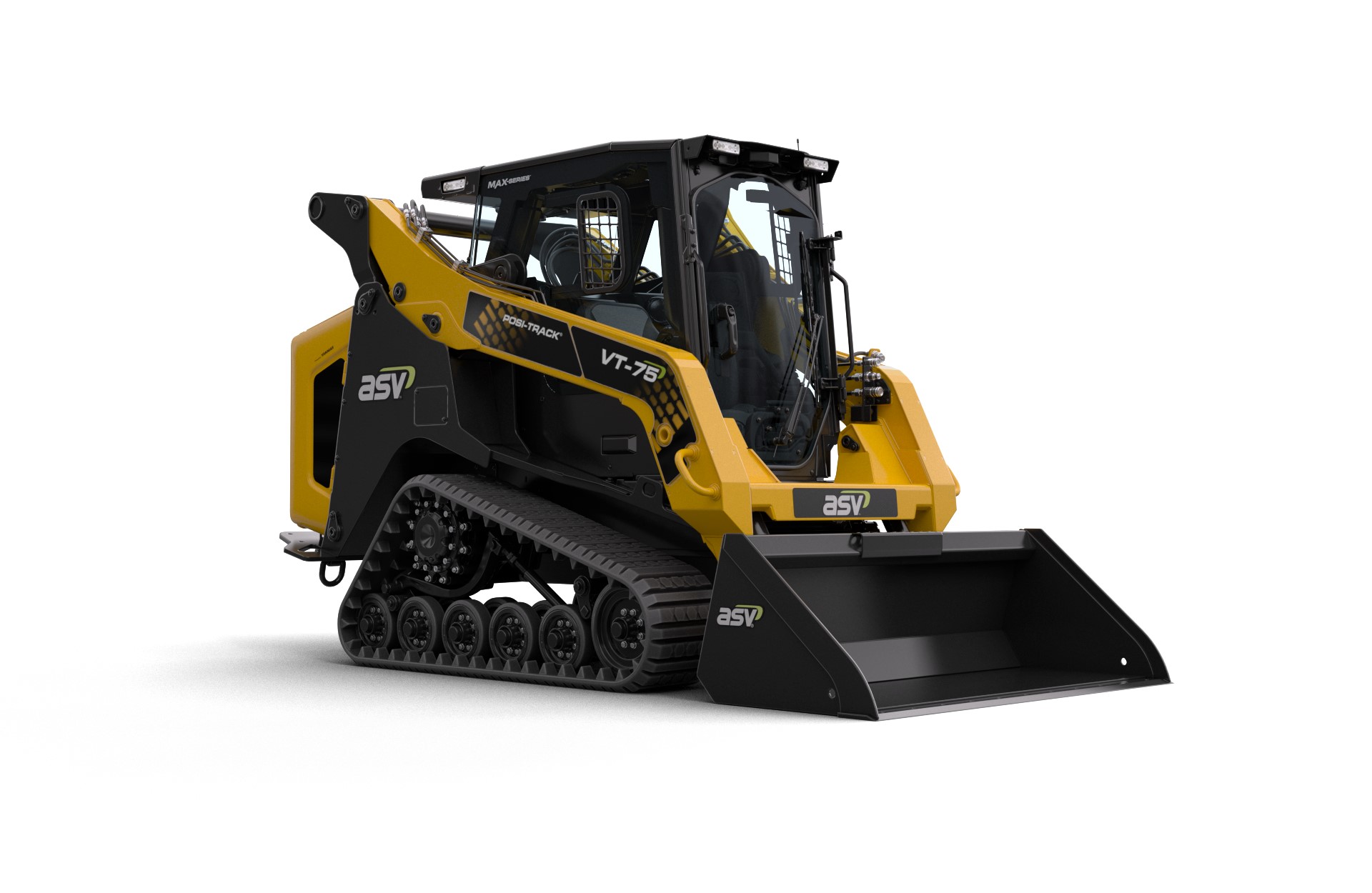
ASV
ASV VT-75-1C
$73,000
Also sold as the Yanmar TL75VP
- Engine
- 72 hp
- Aux flow
- 21.4 GPM
- Weight
- 7,915 lbs
The ASV VT-75-1C is a mid-frame vertical-lift Posi-Track loader that succeeds the long-running RT-75, pairing a 71.5 hp Yanmar turbo-diesel with a 2,300 lb rated capacity and a 10.5-foot lift height. It brings ASV's suspended undercarriage and flotation to operators who need to load over dump truck sides.
Full sheet & owner reports