John Deere
John Deere 334 P-Tier
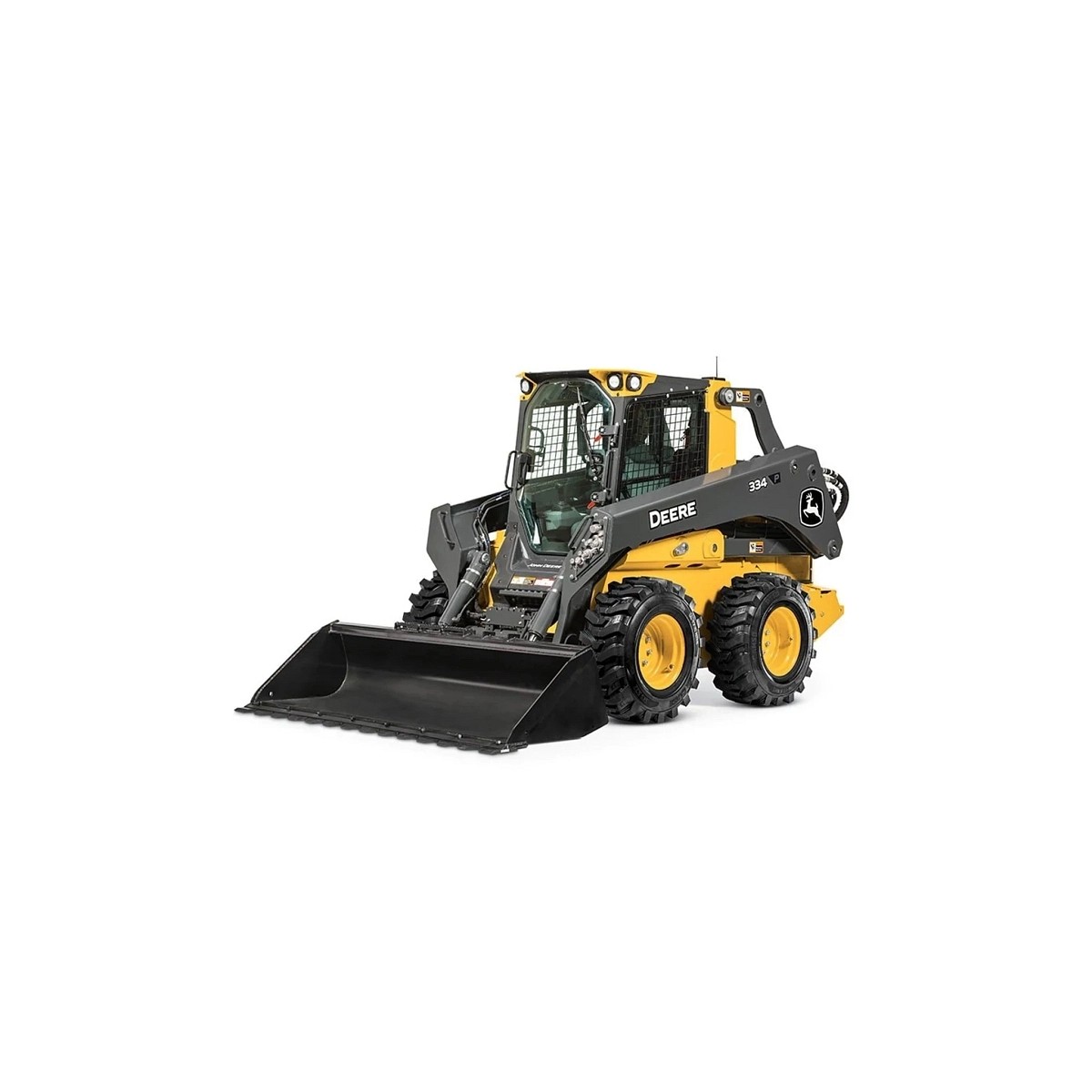
The bright segment is what John Deere 334 P-Tier is rated to carry; the grey run past it is the rest of its tipping load. Bar length is tipping load drawn to the same scale on every machine on the site, so a short bar is a smaller machine and not a conservative rating.
Deere has never built a more powerful skid steer than the 334 P-Tier, which replaces the 332G with a 118 hp turbo Yanmar, a 4,000 lb rated operating capacity, and an optional 44 GPM high-flow system at 4,000 psi. It shares the new one-piece pressurized P-Tier cab and adds standard Attachment Manager, making it a purpose-built platform for cold planers, mulchers, and other hydraulically hungry attachments on wheels.
Suits: Road-work and attachment-heavy contractors who want maximum horsepower and hydraulic flow in a wheeled skid steer Its vertical lift path reaches highest at full extension, for loading high-sided trucks and stacking.
Lifting and reach
- Rated operating capacityWheeled rating convention
- 4,000 lbs
- Tipping load
- 8,000 lbs
- Lift height to hinge pin
- 132 in
- Lift path
- Vertical Lift
- Operating weight
- 10,264 lbs
Power and hydraulics
- Engine power
- 118 hp
- Engine
- Yanmar 4TNV94FHT
- Auxiliary flowStandard circuit
- 25 GPM
- Flow type
- High-Flow
- Warranty
- 2 yr / 2,000 hr
Fitted or available
What this machine can be ordered with. Some of these are standard and some cost extra, and which is which moves between trim levels, so check them against the quote rather than against this list.
What owners report
Summarised from the sources listed below. Nothing here was tested by us.
Deere's biggest wheeled machine, and the first one built specifically around hydraulic attachments rather than around the bucket. With 118 gross horsepower, a 44 GPM high-flow option and a load-sensing system that holds flow as engine speed moves, it is aimed at cold planing, heavy mulching and milling work that used to push a contractor onto a track machine or a dedicated tool carrier. It replaces nothing directly — it is a new size for Deere rather than a refresh — which is both why it is interesting and why nobody has 3,000 hours on one yet.
What you get for the money is hydraulics, reach and fuel. The 132-inch hinge pin loads tri-axles without ceremony, the 35.5-gallon tank is sized for the work that actually empties tanks, and the cab is a generational change rather than a facelift: one-piece, sealed and pressurised, with a touchscreen, an optional surround camera view and tilt-up service access. What you give up is subtlety — at 10,264 lb it is a heavy machine to move, and on a wheeled platform the flotation and grip limits are what they always were. The mechanical items to watch are wheeled ones: oil-bathed drive chains and relief valves rather than an undercarriage, and gear-oil discipline in the final drives, which is where Deere's large wheeled machines have historically been expensive when neglected.
Where it makes sense is a road, milling or site-development contractor who will actually run flow-hungry attachments on firm ground, and for whom tires rather than tracks is the correct cost structure — the difference between a tire set and a track set is thousands of dollars a cycle. It makes much less sense as a general-purpose loader, where the 330 P-Tier does the same lifting to the same height for around $42,000 less. Before signing, confirm whether the quoted capacity assumes counterweights, get the high-flow decision right at order time because it is not a retrofit, ask what transport you are committing to, and understand that you are buying a first-year machine — push hard on warranty terms and on what dealer support looks like if the hydraulics need attention.
What owners like
- The 44 GPM high-flow circuit is the largest Deere puts in a wheeled machine, and it is paired with a pressure-compensated load-sensing system that holds flow regardless of engine speed. That last part is what matters running a cold planer or a mulching head, where engine speed moves constantly and a simpler system lets the attachment fall off with it.
- Vertical lift to a 132-inch hinge pin with a 106.7-inch maximum dump height clears tri-axle sideboards cleanly, so loading trucks is a straight lift rather than a careful piece of positioning.
- The 35.5-gallon fuel tank is genuinely large for a skid steer — ten gallons more than the 330 P-Tier below it — and that is aimed squarely at the high-load hydraulic work that empties tanks fastest. A milling or mulching crew gets a real day out of it instead of a mid-afternoon stop.
- Running on tires rather than tracks removes the single largest cost line on a compact loader. A set of four pneumatic tires on a Deere skid steer runs roughly $930 to $1,524, against thousands for a rubber track set plus rollers and idlers, which is why road crews, demolition cleanup and concrete yards stay on wheels.
- Attachment Manager comes standard on this model and pre-programs flow and pressure for recognised Deere attachments. On a machine with a 44 GPM circuit and expensive tools hanging off the front, that is a genuine protection against whoever climbs in next setting it wrong.
- The redesigned one-piece cab is sealed and pressurised with roughly 20 percent more sightline than the G-Series it derives from, an 8-inch touchscreen and an optional 270-degree camera view, and the whole cab tilts up for drivetrain access rather than making you work through hatches.
What owners complain about
- The headline 4,000 lb rating is quoted with a counterweight set fitted, not on a bare machine. Check how the quote in front of you is actually configured, because the number on the brochure and the number on the machine in the yard are not automatically the same.
- That 4,000 lb also comes from an 8,000 lb tipping load measured on the 50 percent basis wheeled skid steers use, while Deere's track loaders are quoted at 35 percent. So this does not out-carry the 333 P-Tier despite the bigger number — the tracked machine's 3,850 lb sits on an 11,000 lb tipping load and has far more reserve underneath it.
- This is an entirely new model rather than a replacement for an existing one, so there is no field record at all. The highest engine tune Deere has put in a skid steer and its biggest hydraulic circuit are both unproven in owners' hands, which is a real consideration on a six-figure machine.
- At 10,264 lb before you hang anything on the front, the days of moving your skid steer behind a pickup are finished at this size. Transport is a cost and a logistics problem that needs answering before you buy, not after.
- Wheels give up ground in mud, on slopes and on soft fill, and there is no radial-lift alternative anywhere in Deere's mid or large frame if you wanted that geometry for digging and backdragging. A buyer who needs flotation is pushed to the 335 P-Tier track loader and its higher price; a buyer who wants radial has to leave the brand.
- Large-frame Deere wheeled machines drive through oil-bathed final-drive chains, and damaged drive chains and worn relief valves are among the reported problems on the outgoing large frame. On Deere's older large-frame wheeled drives the expensive failure was final-drive gear damage, traced back to skipped gear-oil changes and face-seal leaks left to weep — cheap maintenance that gets expensive when it is missed.
Drawn from aglist.ca, compactequip.com, shop.finaldriveparts.com, skidsteers.com.
What buyers ask
Does it really lift 4,000 lb?
Is it stronger than the 333 P-Tier track loader?
Why choose this over a compact track loader?
Do I need the 44 GPM high-flow package?
Should I worry that it is a brand-new model?
What does it cost to keep running compared to a track machine?
Put the John Deere 334 P-Tier against
Machines in the same range
The rest of the John Deere line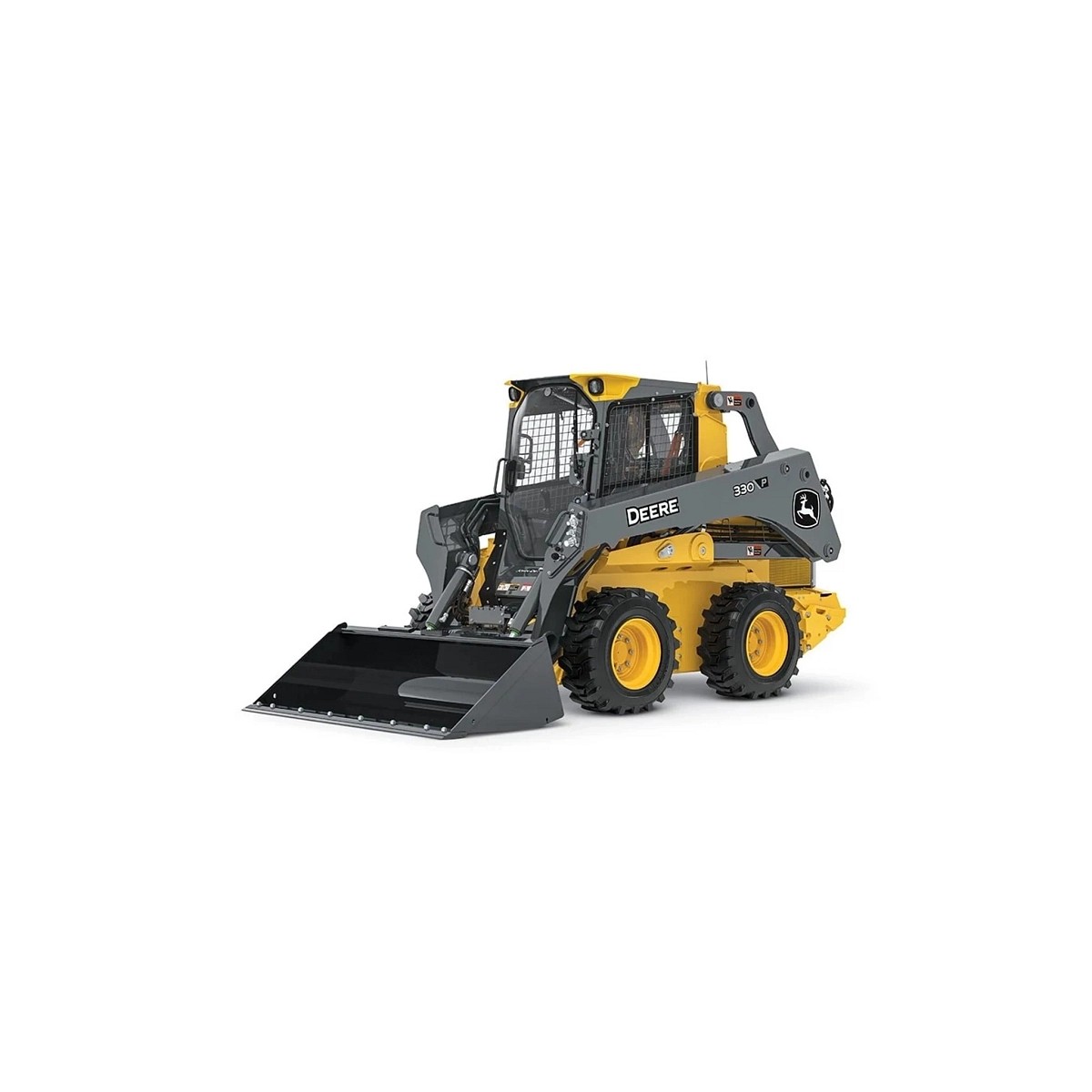
John Deere
John Deere 330 P-Tier
$75,175
- Engine
- 98 hp
- Aux flow
- 25 GPM
- Weight
- 9,930 lbs
Replacing the 330G in mid-2024, the John Deere 330 P-Tier is a large-frame vertical-lift skid steer with a 98 hp turbocharged Yanmar, a brand-new one-piece pressurized cab, and a 25 GPM standard / 39 GPM optional high-flow hydraulic system. It keeps the 330G's 132-inch hinge pin height while adding a touchscreen display, EH dual self-leveling, and larger fuel and DEF tanks for full-day runtime.
Full sheet & owner reports
John Deere
John Deere 324 P-Tier
$67,500
- Engine
- 74 hp
- Aux flow
- 21 GPM
- Weight
- 7,700 lbs
Deere's best-selling skid steer, the 324G, gave way to the 324 P-Tier in mid-2026 as the flagship of the mid-frame wheeled line. The 74 hp turbocharged Yanmar needs no DEF, the vertical-lift boom reaches a 126-inch hinge pin height, and the 2,690 lb rated capacity handles a full pallet of sod or block. EH ISO joystick controls are now standard, and the options list adds ride control, hydraulic self-leveling, a 32 GPM high-flow package, LED lighting, and a rearview camera that the G-Series never offered.
Full sheet & owner reports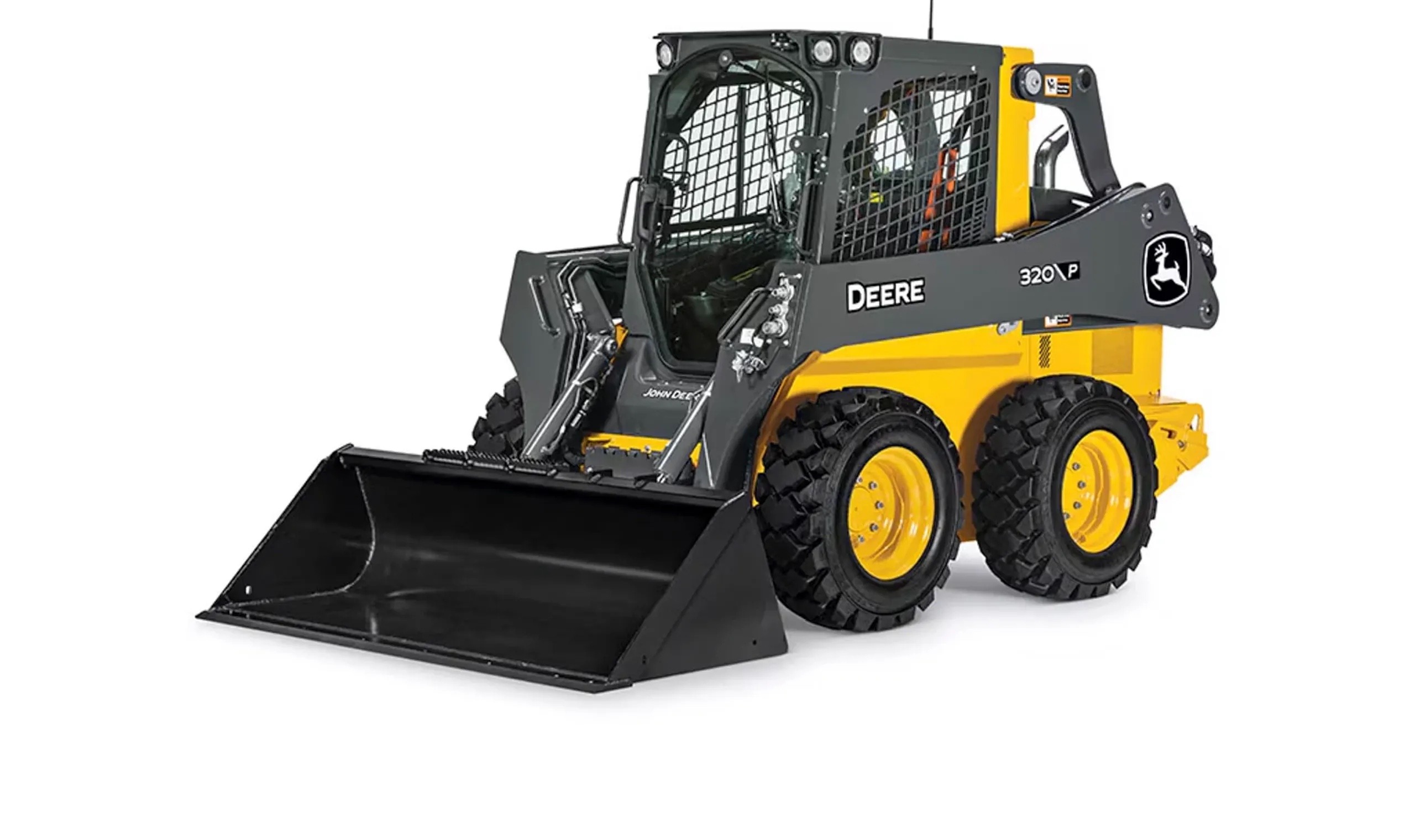
John Deere
John Deere 320 P-Tier
$62,900
- Engine
- 69 hp
- Aux flow
- 21 GPM
- Weight
- 7,150 lbs
Deere's mid-frame vertical-lift wheeled skid steer, the 320 P-Tier, replaced the long-running 320G in mid-2026. It keeps the proven 69 hp Yanmar and 2,190 lb rated capacity while making EH ISO joystick controls standard and adding options the 320G never offered: ride control, hydraulic self-leveling, LED side lighting, a rearview camera, and a 30 GPM high-flow package. The sealed and pressurized cab, 10-foot-2-inch hinge pin height, and standard two-speed transmission make it a do-everything machine for construction, rental, and landscape crews.
Full sheet & owner reports