John Deere
John Deere 330 P-Tier
The bright segment is what John Deere 330 P-Tier is rated to carry; the grey run past it is the rest of its tipping load. Bar length is tipping load drawn to the same scale on every machine on the site, so a short bar is a smaller machine and not a conservative rating.
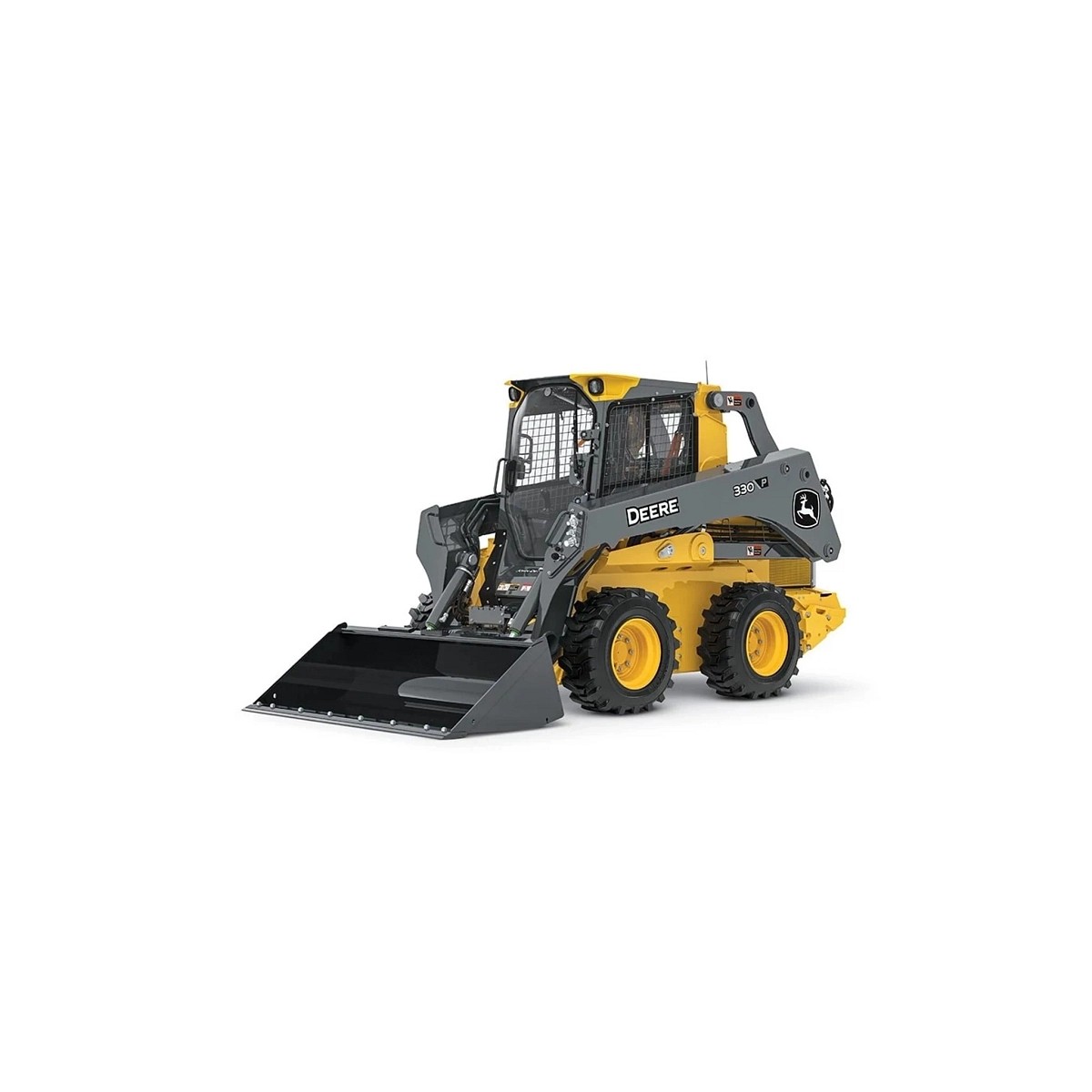
Replacing the 330G in mid-2024, the John Deere 330 P-Tier is a large-frame vertical-lift skid steer with a 98 hp turbocharged Yanmar, a brand-new one-piece pressurized cab, and a 25 GPM standard / 39 GPM optional high-flow hydraulic system. It keeps the 330G's 132-inch hinge pin height while adding a touchscreen display, EH dual self-leveling, and larger fuel and DEF tanks for full-day runtime.
Suits: Heavy loading, truck work, and grading on a modern large-frame wheeled machine with Deere dealer support Its vertical lift path reaches highest at full extension, for loading high-sided trucks and stacking.
Lifting and reach
- Rated operating capacityWheeled rating convention
- 2,950 lbs
- Tipping load
- 5,900 lbs
- Lift height to hinge pin
- 132 in
- Lift path
- Vertical Lift
- Operating weight
- 9,930 lbs
Power and hydraulics
- Engine power
- 98 hp
- Engine
- Yanmar 4TNV94FHT
- Auxiliary flowStandard circuit
- 25 GPM
- Flow type
- Standard
- Warranty
- 2 yr / 2,000 hr
Fitted or available
What this machine can be ordered with. Some of these are standard and some cost extra, and which is which moves between trim levels, so check them against the quote rather than against this list.
What owners report
Summarised from the sources listed below. Nothing here was tested by us.
Large-frame lift without the flagship's hydraulics or its price, which makes this the sensible end of Deere's big wheeled range. Rated 2,950 lb on the 50 percent basis wheeled skid steers use, with 98 gross horsepower and a 5,900 lb tipping load, it replaces the 330G directly and does the same work: loading trucks, moving pallets and material on firm ground, farm and feedyard duty, and general site work where tracks would only add cost. The striking detail is that it lifts to the same 132-inch hinge pin as the far more expensive 334 above it.
The cab is where owners notice the generation change. The one-piece sealed and pressurised design is quieter and keeps dust out in a way the old two-piece cab did not, sightlines are up around 20 percent, and the touchscreen brings diagnostics and camera options that were not previously on offer. Mechanically it is conventional and that is a compliment — the Yanmar engine family has a long service record, and there is no undercarriage to rebuild. What owners of the outgoing machines report going wrong is drive-side: chains and relief valves, both maintenance-sensitive, and final-drive gear oil that costs very little to change and a great deal to ignore. The genuine limitation is the tipping load, which is modest for the machine's physical size and is the number to think about rather than the rated capacity.
Contractors and farms on firm ground who want large-frame reach without the biggest hydraulic circuit are the fit — provided they understand that wheels are the cheaper answer on pavement and the wrong answer in mud. Against its own range, it is the value pick: the same lift height as the 334, most of the cab, and a far smaller invoice. Against rivals, compare the tipping load rather than the rated capacity, because the 50 percent method used for wheeled machines flatters it relative to any track loader you look at alongside. Before signing, settle the high-flow question at order time, confirm the fuel tank size suits your day, and on a used example inspect the drive chains and check the final-drive oil and face seals.
What owners like
- It reaches exactly as high as the flagship. The 132-inch hinge pin is the same figure as the 334 P-Tier, so it loads tandem and tri-axle trucks just as cleanly for roughly $42,000 less — for most buyers that is the single most useful fact about this machine.
- The optional 39 GPM high-flow package puts cold planers, mulchers and commercial snow blowers within reach of a wheeled machine, work that previously pushed buyers onto tracks and into a higher running cost they did not need on firm ground.
- The one-piece sealed and pressurised cab is the generational change here rather than any number on the spec sheet. Operators coming out of the two-piece G-Series cab describe it as quieter, cleaner on dusty sites and far better for visibility, with around 20 percent more sightline and a touchscreen with onboard diagnostics.
- Ninety-eight gross horsepower through the well-known Yanmar 4TNV94FHT — the same engine family that ran seven years in Deere's large-frame machines with a reliability reputation owners generally endorse, provided the filters and fuel are actually looked after.
- Running on tires removes the undercarriage entirely. Against a comparable track loader you are trading a rubber track set costing thousands, plus rollers and idlers, for tires and an oil-bathed drive chain — on pavement, concrete and demolition cleanup that difference dominates the hourly cost.
What owners complain about
- The 5,900 lb tipping load is the real limit and it is modest for the size of the machine. Because wheeled skid steers are rated at 50 percent of tipping load, the 2,950 lb headline sits on much less reserve than the 331 P-Tier track loader beside it, which reaches 3,150 lb from a 9,000 lb tipping load. At full height with an awkward load, that difference is what you feel.
- The 25.5-gallon fuel tank is ten gallons smaller than the 334's, and that gap opens up precisely when you are running the high-flow circuit hard. On sustained hydraulic work this is the machine that needs a mid-day stop while the bigger one does not.
- High flow is an option and needs ordering up front. The 25 GPM standard circuit is fine for buckets, forks, augers and brooms, but it will not properly drive the planers and mulchers that justify buying this size in the first place.
- Wheeled machines this size lose traction in mud and on slopes where the equivalent 331 P-Tier track loader keeps working, and there is no radial-lift option anywhere in Deere's mid or large frame — so a buyer who wants flotation pays for tracks, and a buyer who wants radial geometry has to shop another brand entirely.
- Reported problems on the outgoing large-frame wheeled machines centre on the drive system rather than the engine: damaged drive chains needing inspection and replacement, and defective relief valves. These are maintenance-driven failures, and gear-oil discipline in the final drives is the cheapest insurance against the expensive version of them.
Drawn from aglist.ca, compactequip.com, shop.finaldriveparts.com, reynoldsfarmequipment.com.
What buyers ask
How is this different from the 334 P-Tier?
Should I buy this or the 331 P-Tier track loader?
Why is the rated capacity measured differently from a track loader?
Do I need the high-flow hydraulics?
What goes wrong with these?
Is it big enough to be my only machine?
Put the John Deere 330 P-Tier against
Machines in the same range
The rest of the John Deere line
John Deere
John Deere 324 P-Tier
$67,500
- Engine
- 74 hp
- Aux flow
- 21 GPM
- Weight
- 7,700 lbs
Deere's best-selling skid steer, the 324G, gave way to the 324 P-Tier in mid-2026 as the flagship of the mid-frame wheeled line. The 74 hp turbocharged Yanmar needs no DEF, the vertical-lift boom reaches a 126-inch hinge pin height, and the 2,690 lb rated capacity handles a full pallet of sod or block. EH ISO joystick controls are now standard, and the options list adds ride control, hydraulic self-leveling, a 32 GPM high-flow package, LED lighting, and a rearview camera that the G-Series never offered.
Full sheet & owner reports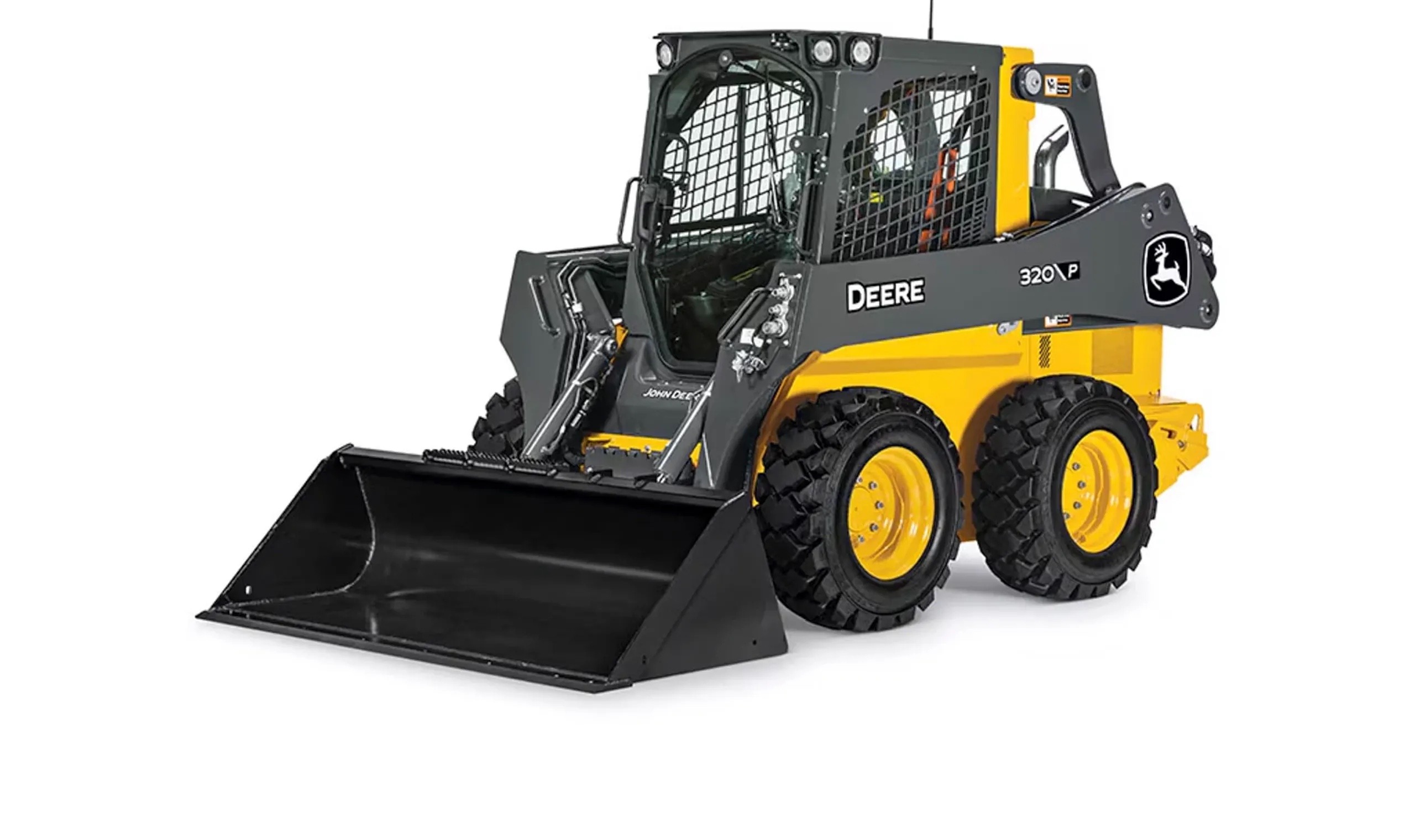
John Deere
John Deere 320 P-Tier
$62,900
- Engine
- 69 hp
- Aux flow
- 21 GPM
- Weight
- 7,150 lbs
Deere's mid-frame vertical-lift wheeled skid steer, the 320 P-Tier, replaced the long-running 320G in mid-2026. It keeps the proven 69 hp Yanmar and 2,190 lb rated capacity while making EH ISO joystick controls standard and adding options the 320G never offered: ride control, hydraulic self-leveling, LED side lighting, a rearview camera, and a 30 GPM high-flow package. The sealed and pressurized cab, 10-foot-2-inch hinge pin height, and standard two-speed transmission make it a do-everything machine for construction, rental, and landscape crews.
Full sheet & owner reports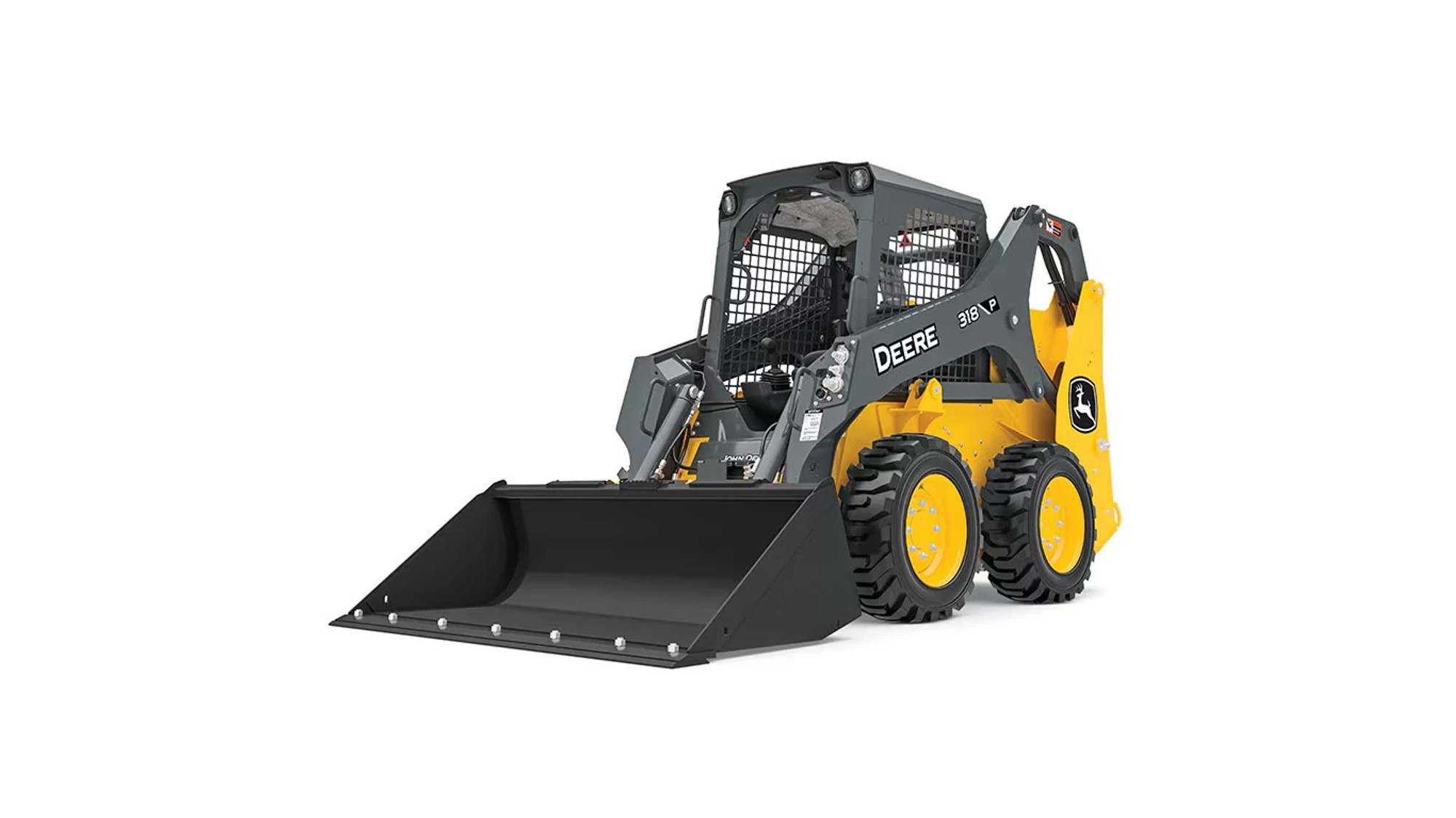
John Deere
John Deere 318 P-Tier
$59,342
- Engine
- 65 hp
- Aux flow
- 17 GPM
- Weight
- 6,542 lbs
Sub-63-inch width and a pickup-towable weight made the 318G a rental and landscaper staple, and the 318 P-Tier keeps both. It's the small-frame vertical-lift wheeled skid steer that replaced the long-running 318G, adding a larger sealed cab, standard EH ISO joysticks, and options like ride control, self-leveling, and a rearview camera. The 65 hp turbo Yanmar meets Tier 4 Final with no DEF, and counterweight packages push rated capacity to 2,095 lbs for pallet work.
Full sheet & owner reports