John Deere
John Deere 318 P-Tier
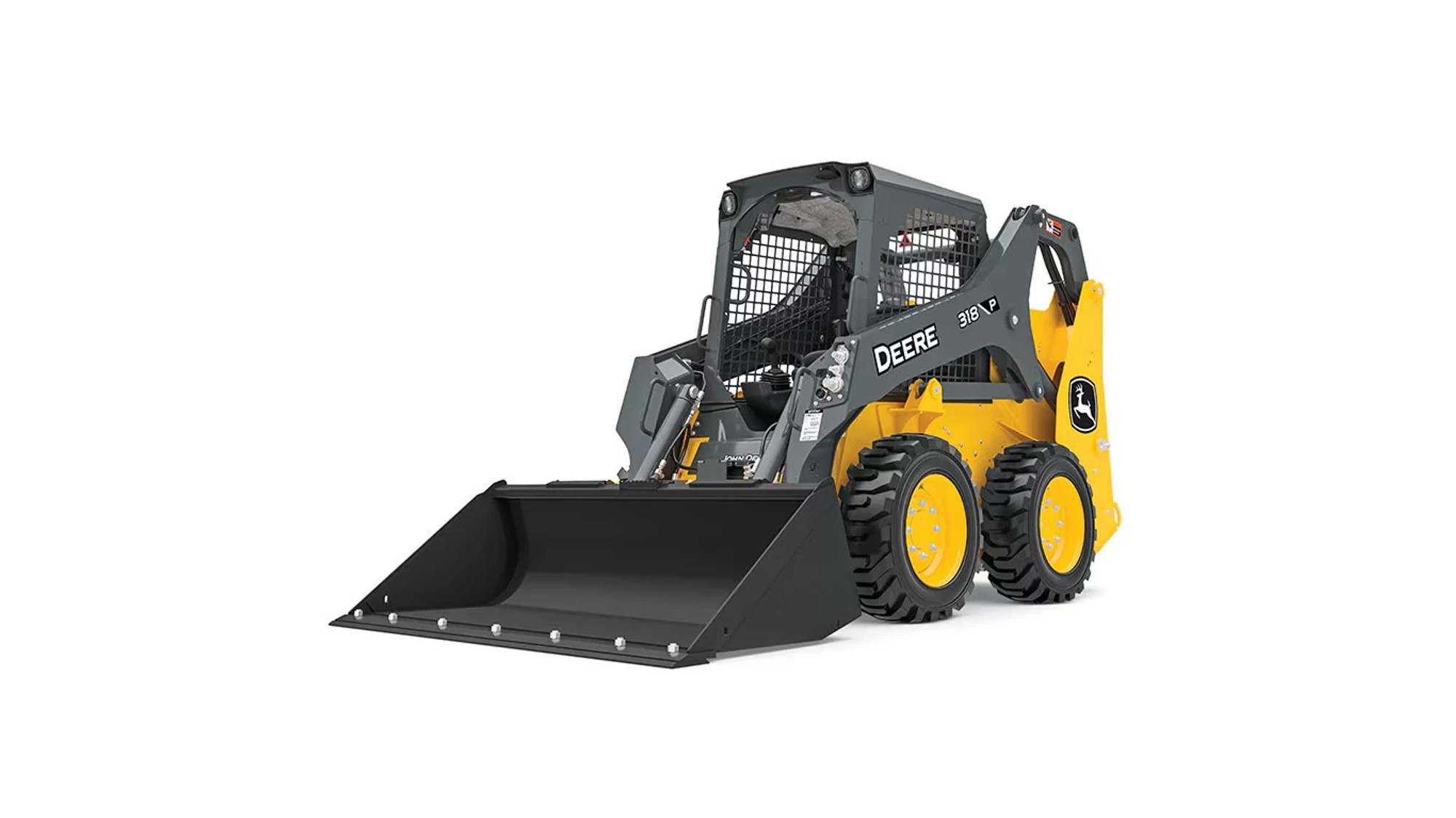
The bright segment is what John Deere 318 P-Tier is rated to carry; the grey run past it is the rest of its tipping load. Bar length is tipping load drawn to the same scale on every machine on the site, so a short bar is a smaller machine and not a conservative rating.
One caveat on this machine: we could not find a published tipping load for it, so the figure above is its advertised capacity divided by the fraction its maker rates at. That makes the grey run arithmetic rather than a measurement, and it is the number worth asking a dealer to confirm.
Sub-63-inch width and a pickup-towable weight made the 318G a rental and landscaper staple, and the 318 P-Tier keeps both. It's the small-frame vertical-lift wheeled skid steer that replaced the long-running 318G, adding a larger sealed cab, standard EH ISO joysticks, and options like ride control, self-leveling, and a rearview camera. The 65 hp turbo Yanmar meets Tier 4 Final with no DEF, and counterweight packages push rated capacity to 2,095 lbs for pallet work.
Suits: Pallet and truck loading in tight spaces, from a towable vertical-lift Deere Its vertical lift path reaches highest at full extension, for loading high-sided trucks and stacking.
Lifting and reach
- Rated operating capacityWheeled rating convention
- 1,945 lbs
- Tipping loadDerived from the advertised capacity, not published
- 3,890 lbs
- Lift height to hinge pin
- 120 in
- Lift path
- Vertical Lift
- Operating weight
- 6,542 lbs
Power and hydraulics
- Engine power
- 65 hp
- Engine
- Yanmar 4TNV86CHT
- Auxiliary flowStandard circuit
- 17 GPM
- Flow type
- Standard
- Warranty
- 2 yr / 2,000 hr
Fitted or available
What this machine can be ordered with. Some of these are standard and some cost extra, and which is which moves between trim levels, so check them against the quote rather than against this list.
What owners of the same hardware report
Nobody has written up this exact machine yet, so this is drawn from reports on the machines that share its hardware — the model it replaced, a sibling on the same platform, or the same machine sold under another badge. The prose says which in each case. It is accurate about the iron rather than about this particular model.
Narrow and light is the case for this machine, and everything else follows from it. At 62.9 inches wide and 6,542 lbs it goes between houses and through residential gates where the Bobcat and Cat machines in the same class cannot, and it tows behind a half-ton. No owner has published an account of the P-Tier badge at hours yet, but that matters less here than usual: the 318G it replaced runs the same Yanmar 4TNV86CHT, the same vertical-lift boom, the same 1,945 lb rating off the same 3,890 lb tipping load and the same 17 gpm circuit, so 318G owner reporting describes this iron.
What those owners describe is an unremarkable machine in the good sense. No catastrophic failure pattern on the 2.1-litre Yanmar, strong dealer parts support, and a well-regarded electrohydraulic joystick package once the response is dialled in - people arriving from mechanical foot-and-hand controls find it touchy at first. The recurring costs are wheels and age rather than drivetrain: tires wear fast on concrete and demolition debris, and machines past 2,000 hours routinely show corroded battery terminals, starter solenoid faults and parking-brake sensor problems. Vertical lift and a 120-inch hinge pin give it the highest dump in Deere's small frame, and 6,000 lbs of bucket breakout is the strongest there too.
This suits an owner-operator or landscape crew loading pickups and dump trailers on firm ground, where narrow access matters more than raw capacity. Cross-shop it against the tracked 317 P-Tier if soft ground or winter is your daily reality, and against Deere's own radial-lift 316 P-Tier if the work is mostly grading rather than lifting - same engine, lower price, different geometry. Before signing, confirm on the build sheet whether two-speed and the joystick performance package are actually on the quote, get the aftertreatment specification in writing because published sources disagree about it, and accept that 17 gpm with no high-flow option is a permanent limit on what this machine will ever run.
What owners like
- Under 63 inches wide and 6,542 lbs, it is the narrowest and lightest vertical-lift machine in its competitive set. Owners of the 318G - the same machine under Deere's previous naming, sharing the engine, boom, hydraulics and tipping load exactly - buy it for that: it fits a residential gate that a Bobcat S66 or a Cat 246D3 will not, and it trailers behind a half-ton.
- Vertical lift with a 120-inch hinge pin and 94.3 inches of dump height is the most reach at height Deere offers in the small frame, and the geometry keeps the load close to the machine through the cycle rather than pitching it forward. For loading pickup boxes and dump trailers and for stacking pallets, that is the right linkage.
- Bucket breakout is 6,000 lbs, the strongest in Deere's small frame, and the 2.1-litre Yanmar makes 153 lb-ft at 1,690 rpm - torque low enough in the range to keep pushing through dense material rather than bogging.
- The counterweight package raises rated capacity from 1,945 lbs to 2,095 lbs, which is the difference between most of a pallet and all of it. On a machine this light it is a cheap option that materially changes what it will carry.
- 318G owners rate the electrohydraulic joystick package well once it is set up: switchable ISO and H patterns, creep mode for attachments that need full hydraulic flow at low ground speed, adjustable boom and bucket response, and differential steering that speeds the outside wheels through a turn.
- Reporting on the 318G turns up no catastrophic failure pattern on the Yanmar - the recurring description is of a mechanically straightforward machine well supported by the dealer parts network. A single person can lock the boom and tilt the operator's station for drivetrain access in about two minutes.
What owners complain about
- The 1,945 lb rating is 50 percent of a 3,890 lb tipping load, the convention Deere uses for wheeled skid steers. Compact track loaders are rated at 35 percent. Cross-shopped against a CTL showing the same number, this machine is holding noticeably less reserve - and at least one widely circulated guide to the 318G gets this backwards and labels the figure 35 percent while printing the 3,890 lb tipping load right beside it.
- Seventeen gpm at 3,450 psi with no high-flow option at all is the hard ceiling on this machine. Augers, breakers, trenchers, power rakes, brooms and grapples are fine; mulchers, cold planers and large snow blowers are simply not on the list, and no amount of specifying fixes that.
- Single-speed travel at 6.9 mph is the base configuration. Two-speed is an option that takes it to 10.1 mph, and on any site bigger than a suburban lot the base machine spends real money crawling between work areas.
- 318G owners coming off mechanical foot-and-hand controls describe the electrohydraulic joysticks as touchy until they are dialled in. The performance package's adjustable response is the fix, but it is an option, and this is a good reason to demo before ordering rather than after.
- At 2,000-plus hours, 318G machines commonly turn up with corroded battery terminals, intermittent starter solenoid faults and parking-brake sensor problems - routine wear rather than a design flaw, but a standard list of pre-purchase findings. Tires are the other recurring bill: on concrete, gravel and demolition debris a wheeled machine eats them, and a quality replacement set runs from several hundred dollars into four figures.
- The aftertreatment story does not add up between sources. A prominent 318G buyer's guide describes DEF and SCR with a particulate filter inspection every 1,000 hours, while Deere's own published 318G specification lists Final Tier 4 compliance without mentioning exhaust fluid or a particulate filter anywhere. Which is right changes the maintenance bill and the cold-weather routine, so get it confirmed against the build sheet in writing.
Drawn from aglist.ca, deere.com, qualityequip.com.
What buyers ask
Is the 318 P-Tier different from the 318G?
Can it run a mulcher or a cold planer?
Why is its 1,945 lb rating not comparable to a track loader's?
Should I buy the tracked 317 P-Tier instead?
What should I check on a used 318G or 318 P-Tier?
Does it need DEF?
Put the John Deere 318 P-Tier against
Machines in the same range
The rest of the John Deere line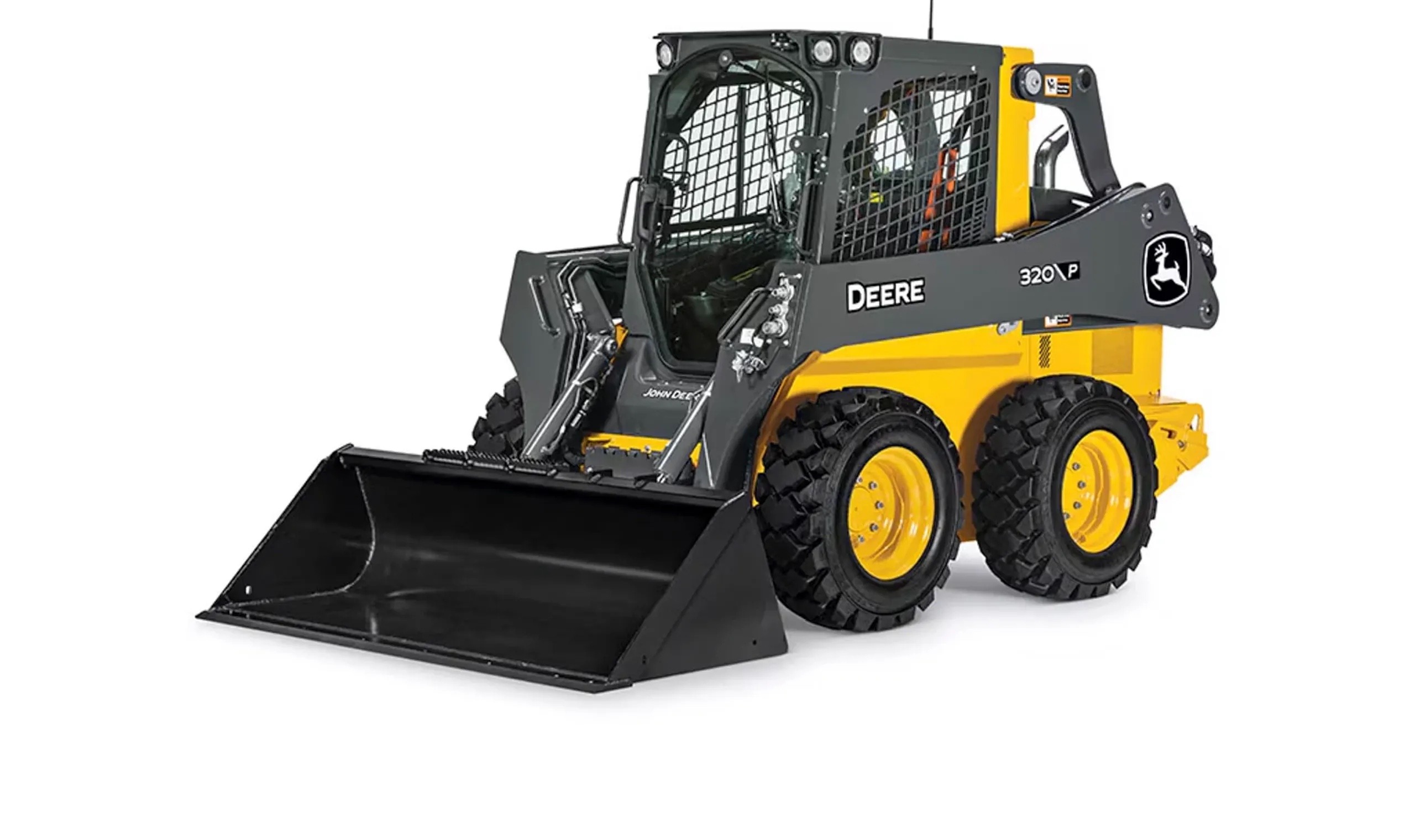
John Deere
John Deere 320 P-Tier
$62,900
- Engine
- 69 hp
- Aux flow
- 21 GPM
- Weight
- 7,150 lbs
Deere's mid-frame vertical-lift wheeled skid steer, the 320 P-Tier, replaced the long-running 320G in mid-2026. It keeps the proven 69 hp Yanmar and 2,190 lb rated capacity while making EH ISO joystick controls standard and adding options the 320G never offered: ride control, hydraulic self-leveling, LED side lighting, a rearview camera, and a 30 GPM high-flow package. The sealed and pressurized cab, 10-foot-2-inch hinge pin height, and standard two-speed transmission make it a do-everything machine for construction, rental, and landscape crews.
Full sheet & owner reports
John Deere
John Deere 324 P-Tier
$67,500
- Engine
- 74 hp
- Aux flow
- 21 GPM
- Weight
- 7,700 lbs
Deere's best-selling skid steer, the 324G, gave way to the 324 P-Tier in mid-2026 as the flagship of the mid-frame wheeled line. The 74 hp turbocharged Yanmar needs no DEF, the vertical-lift boom reaches a 126-inch hinge pin height, and the 2,690 lb rated capacity handles a full pallet of sod or block. EH ISO joystick controls are now standard, and the options list adds ride control, hydraulic self-leveling, a 32 GPM high-flow package, LED lighting, and a rearview camera that the G-Series never offered.
Full sheet & owner reports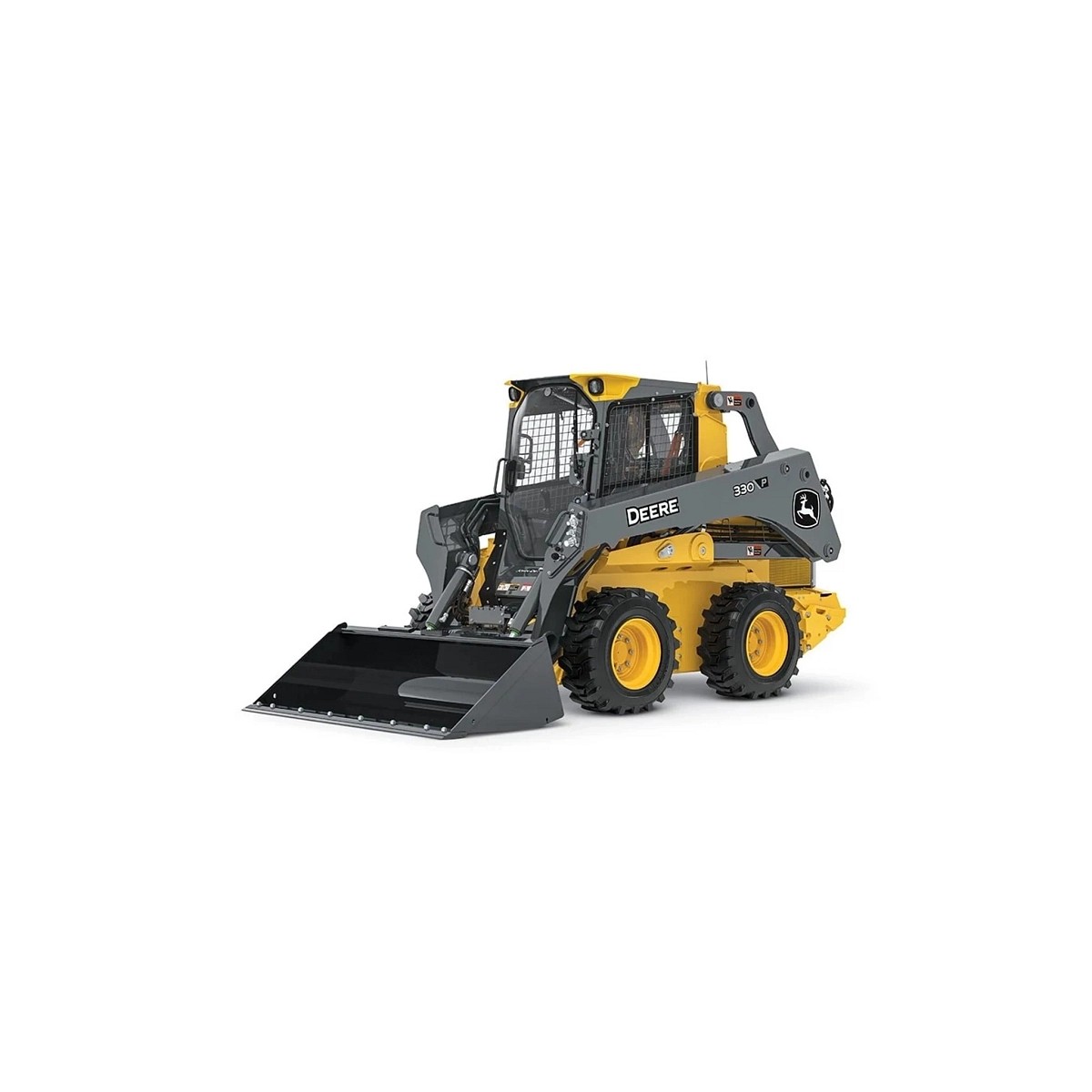
John Deere
John Deere 330 P-Tier
$75,175
- Engine
- 98 hp
- Aux flow
- 25 GPM
- Weight
- 9,930 lbs
Replacing the 330G in mid-2024, the John Deere 330 P-Tier is a large-frame vertical-lift skid steer with a 98 hp turbocharged Yanmar, a brand-new one-piece pressurized cab, and a 25 GPM standard / 39 GPM optional high-flow hydraulic system. It keeps the 330G's 132-inch hinge pin height while adding a touchscreen display, EH dual self-leveling, and larger fuel and DEF tanks for full-day runtime.
Full sheet & owner reports