New Holland
New Holland L316

The bright segment is what New Holland L316 is rated to carry; the grey run past it is the rest of its tipping load. Bar length is tipping load drawn to the same scale on every machine on the site, so a short bar is a smaller machine and not a conservative rating.
A light 5370 lb frame and narrow footprint make the L316 a value pick for landscaping, barns, and tight-access work. It's the smallest wheeled skid steer in New Holland's 300 Series, a radial-lift machine powered by a 60 hp FPT diesel.
Also sold as
The same machine is sold as the Case SR160B — different paint, different dealer network, same hardware, so the choice is usually about which dealer is closer and which one you would rather owe a service call to.
Suits: Light, budget-friendly work in tight spaces Its radial lift path reaches furthest at mid-height, for digging, grading and backfilling.
Lifting and reach
- Rated operating capacityWheeled rating convention
- 1,600 lbs
- Tipping load
- 3,200 lbs
- Lift height to hinge pin
- 112 in
- Lift path
- Radial Lift
- Operating weight
- 5,645 lbs
Power and hydraulics
- Engine power
- 60 hp
- Engine
- FPT
- Auxiliary flowStandard circuit
- 18.4 GPM
- Flow type
- Standard
- Warranty
- 2 yr / 2,000 hr
Fitted or available
What this machine can be ordered with. Some of these are standard and some cost extra, and which is which moves between trim levels, so check them against the quote rather than against this list.
What owners of the same hardware report
Nobody has written up this exact machine yet, so this is drawn from reports on the machines that share its hardware — the model it replaced, a sibling on the same platform, or the same machine sold under another badge. The prose says which in each case. It is accurate about the iron rather than about this particular model.
Price is the argument here, and New Holland does not pretend otherwise - this is the cheapest way into a new construction-grade machine from a name brand, and the specification is written accordingly. Nobody has published an ownership account of this badge, but that matters less than it sounds: Case sells the identical machine as the SR160B, down to the horsepower, the torque figure, the rated capacity and the hydraulic circuit, and the previous-generation SR160 has been owned and complained about in public for years. That is the evidence this entry rests on.
What the shared platform gives you is a genuinely small machine - a shade over six feet tall, behind a 60-inch bucket - with quick boom cycles and a cab and boom that tilt forward as one for service access. What it does not give you is height or hydraulic muscle. Maximum dump height is 84.8 inches, which is a pickup box rather than a dump truck, and radial lift pulls the load back toward the machine at the top of the cycle. The circuit is 18.4 gpm but at only 3,050 psi on Case's published figure, which delivers less at the coupler than rivals quoting a smaller flow at higher pressure, and there is no high-flow option. One owner's experience on the previous generation is worth knowing: filter-related fault codes put the machine in limp mode, and the fix turned out to be a $3,500 ECU rather than the filter.
This is the right machine for a property owner, a small landscape operation or anyone whose alternative is a well-used machine of unknown history, where a warranty and a dealer matter more than capability. Do not buy it expecting to grow into it - 1,600 lbs at 50 percent of tipping load, under 8 mph with no two-speed, and 84.8 inches of dump height are all hard limits. Before signing, weigh the machine as configured rather than believing either of New Holland's two published weights, get the aftertreatment specification and the auxiliary pressure in writing, and price the identical Case badge at whichever dealer is closer to your yard.
What owners like
- Case sells the identical machine as the SR160B - same 60 hp gross and 57 hp net, same 139 lb-ft peak torque, same 1,600 lb rating, same 18.4 gpm circuit, same radial lift, same two-year 2,000-hour engine coverage. A buyer can take whichever badge has the closer dealer, and owners of these small CNH machines put dealer distance near the top of what actually costs them in downtime.
- It is small in the ways that matter on a residential job: a shade over six feet tall, sitting behind a 60-inch bucket, and light enough that trailering it is not a planning exercise. Getting through a side yard and under low branches is most of the job on this kind of work.
- Boom cycle times are quick for the price bracket - New Holland publishes 3.2 seconds to raise and two seconds to lower, which on repetitive loading is where a cheap machine either earns its keep or does not.
- The whole cab and boom assembly tilts forward as a unit, which makes component access and cab cleanout a genuinely quick job rather than a dealer visit. All daily service points are grouped behind a rear door and hood that open without tools.
- Ride Control and Self Level are both available, and creep mode is offered on electrohydraulic builds for slow-speed trenching. Those are the options worth having on a machine that will spend its life carrying loads across rough ground.
What owners complain about
- New Holland's own product page contradicts itself on how much this machine weighs: the description calls it a nimble 5,645 lbs while the specification block on the same page says 5,370 lbs. Case publishes 5,645 lbs for the identical SR160B, which suggests the lower figure is the stale one. If trailer margin is tight, weigh the actual machine rather than trusting either number.
- Maximum dump height is 84.8 inches with 18.5 inches of reach at height. That is a pickup box and a low dump trailer. It will not clear the side of a tandem dump truck, and radial lift means it swings the load back toward the machine at the top of the cycle rather than out over the obstacle.
- The 1,600 lb rating is 50 percent of a 3,200 lb tipping load - the convention New Holland and Case both use. Most compact track loaders quote 35 percent. So the same number on a rival's brochure means more reserve than it does here, and 1,600 lbs was never going to be a full pallet of sod or stone anyway.
- The flow figure flatters it. Case publishes the shared circuit as 18.4 gpm at 3,050 psi, and pressure is half of what makes hydraulic power - that combination works out to less at the coupler than a rival making 17 gpm at 3,450 psi. Flow alone is the wrong number to shop attachments on, and there is no high-flow option here regardless.
- There is no two-speed travel. Just under 8 mph is the whole range, which is fine on a small lot and tiresome anywhere bigger.
- An owner of the previous-generation SR160 - the same small CNH platform - had the machine drop into limp mode on filter-related fault codes about 100 hours into ownership. Cleaning the filter did not fix it; testing found a failed ECU, replaced at $3,500. Confirm what aftertreatment the current build carries, and pull the fault history on any used example before money changes hands.
- Wheels and radial lift together limit it twice over: it gives up traction in mud and on slopes to a small track loader, and gives up height and reach at the top of the cycle to a vertical-lift machine. It is a cheap machine that is honest about being one, but both limits are permanent.
Drawn from construction.newholland.com, casece.com, skidsteerforum.com.
What buyers ask
Which weight is right - 5,370 lbs or 5,645 lbs?
Is this the same machine as the Case SR160B?
Can it load a dump truck?
Is 18.4 gpm enough for attachments?
What should I watch for on a used one?
Should I stretch to a bigger machine instead?
Put the New Holland L316 against
Machines in the same range
The rest of the New Holland line
New Holland
New Holland L318
$45,000
- Engine
- 60 hp
- Aux flow
- 20.6 GPM
- Weight
- 6,230 lbs
Super Boom vertical lift comes down to the 1800 lb class in the New Holland L318, a small-frame wheeled skid steer powered by a 60 hp FPT diesel. It offers truck-loading reach that radial small frames can't match.
Full sheet & owner reports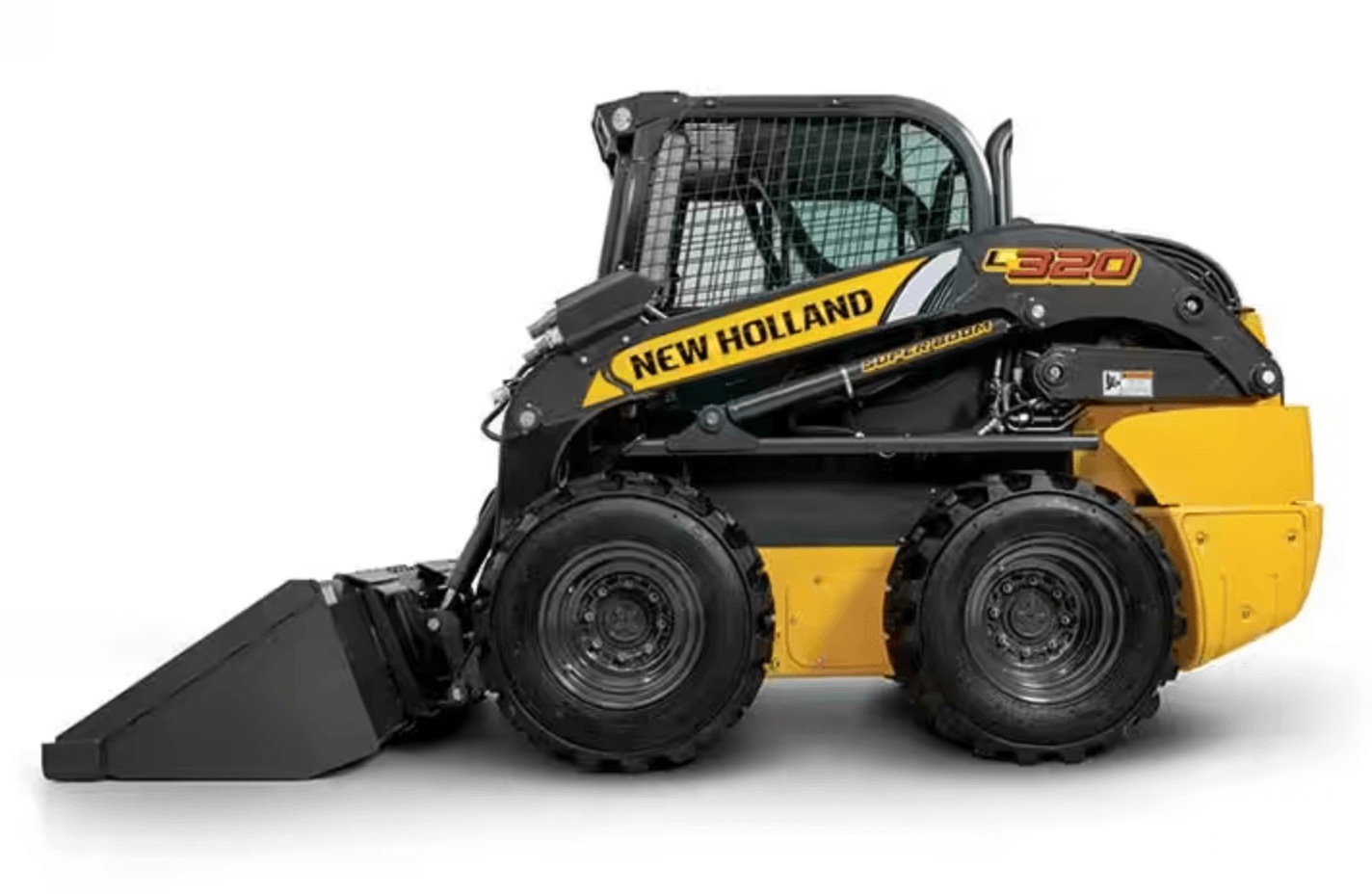
New Holland
New Holland L320
$48,000
- Engine
- 67 hp
- Aux flow
- 20.6 GPM
- Weight
- 6,470 lbs
2000 lbs of capacity, standard dual-range travel, and a 91.7-inch dump height put the New Holland L320 at the sweet spot of the smaller 300 Series frames. It's a mid-size wheeled skid steer with the patented Super Boom vertical lift and a 67 hp FPT diesel.
Full sheet & owner reports
New Holland
New Holland L334
$65,000
Also sold as the Case SV340B
- Engine
- 90 hp
- Aux flow
- 24.2 GPM
- Weight
- 9,100 lbs
The New Holland L334 is the flagship wheeled skid steer of the 300 Series, pairing a 90 hp FPT diesel with the patented Super Boom vertical lift and 3400 lbs of rated capacity. It's built for heavy truck-loading and high-flow attachment work.
Full sheet & owner reports