Takeuchi
Takeuchi TL10V2
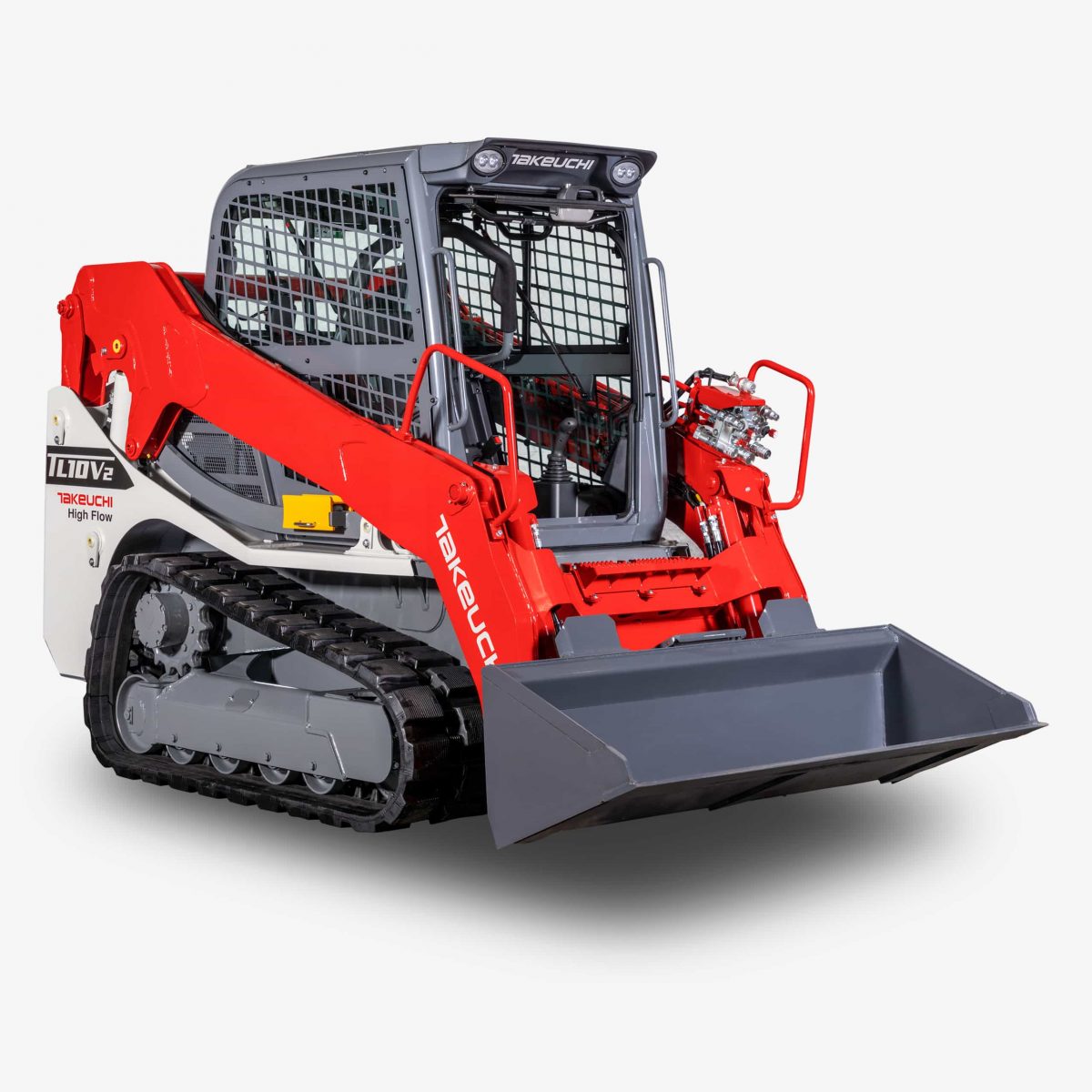
The bright segment is what Takeuchi TL10V2 is rated to carry; the grey run past it is the rest of its tipping load. Bar length is tipping load drawn to the same scale on every machine on the site, so a short bar is a smaller machine and not a conservative rating.
Built heavy at over 10,000 lbs with a 74.3 hp Kubota diesel, the Takeuchi TL10V2 is a mid-frame vertical-lift compact track loader from the company that invented the CTL. It sits between the TL8 and TL12V2 for contractors who prize Takeuchi's tank-like construction and undercarriage.
Suits: Takeuchi's heavy build and undercarriage durability in a mid-frame vertical-lift package Its vertical lift path reaches highest at full extension, for loading high-sided trucks and stacking.
Lifting and reach
- Rated operating capacityTrack loader rating convention
- 2,525 lbs
- Tipping load
- 7,210 lbs
- Lift height to hinge pin
- 124.8 in
- Lift path
- Vertical Lift
- Operating weight
- 10,270 lbs
Power and hydraulics
- Engine power
- 74 hp
- Engine
- Kubota V3307-CR-TE4B
- Auxiliary flowStandard circuit
- 18.8 GPM
- Flow type
- Standard
- Warranty
- 2 yr / 2,000 hr
Fitted or available
What this machine can be ordered with. Some of these are standard and some cost extra, and which is which moves between trim levels, so check them against the quote rather than against this list.
What owners report
Summarised from the sources listed below. Nothing here was tested by us.
People who buy this one are usually buying the undercarriage. Takeuchi invented the category and its owner base argues about roller design and track hours more than any other brand's, and the reports that keep the reputation alive are the unglamorous kind - machines past 1,500 hours on original tracks with nothing done underneath. At 10,270 lb it is also simply built heavier than most of its class, and operators describe that weight as pushing power and slope stability rather than as bulk.
Against its obvious rival it is the better-mannered machine: operators who have run both call Kubota's SVL75 rough riding and sluggish in the hydraulics by comparison. The vertical lift path and close to 125 inches of pin height load trucks properly. What owners actually chase on this model is electrical - corroded grounds, damaged harness sections, emissions sensor codes that need dealer software - and diesel particulate filter regeneration, with machines turning up stuck in limp mode on a PM5 code. Undercarriage parts are ordinary and individually replaceable, around $500 a bottom roller and $550 an idler, with tracks about $1,230 each.
The owner who keeps machines a long time cares more about what the undercarriage costs over six years than what the spec sheet says on day one. Against the SVL75-3 it is heavier, smoother and dearer; against the original TL10 it is meaningfully slower, because 74.3 hp was chosen to duck the DEF threshold rather than to do more work. Before signing, pull the machine onto level ground and inspect rollers, idlers and sprockets individually, ask whether high flow is fitted since 18.8 gpm standard is thin for the weight, and check what the nearest dealer charges for diagnostic time.
What owners like
- Undercarriage longevity is the reason this brand has the following it has, and it is not marketing - owners of Takeuchi-family track loaders report running past 1,500 hours on original tracks with nothing done to the undercarriage at all, in an era when operators of some competing machines were changing tracks at a fraction of that. It is the single largest recurring cost on a track loader, so a machine that is genuinely good at it saves real money rather than bragging rights.
- The undercarriage is also built to be rebuilt piece by piece rather than as an assembly, and the parts are ordinary shelf items: bottom rollers around $500, dual-flange rollers around $530, front idlers around $550, drive sprockets around $320. You replace what is worn. Operators who have lived with suspended-undercarriage machines describe those instead as an expensive can of worms with far more parts that eventually need replacing.
- It shares its bottom roller part number with the smaller TL6 and TL8R2, so the highest-wear item in the whole machine is a common part across three models rather than a model-specific order.
- At 10,270 lb it is built noticeably heavier than same-class rivals, and that weight shows up as pushing power and as stability on side slopes rather than as dead mass.
- Operators who have run it against the obvious cross-shop, Kubota's SVL75, describe the Kubota as rough riding, occasionally short on power and sluggish in the hydraulics, while the Takeuchi is the smoother and better-mannered machine to spend a day in.
- The 74.3 hp Kubota V3307 requires no DEF and shares its engine family with Kubota's own SVL75, which means any decent diesel shop knows it and parts are available everywhere rather than through one franchise.
- The vertical lift path with close to 125 inches of bucket pin height loads dump trucks cleanly, which is the whole reason to choose this over the radial TL8R2 below it.
What owners complain about
- The power drop was deliberate and it is permanent: the previous TL10 carried essentially the same engine as the TL12 at around 92 hp, and the V2 was redesigned down to 74.3 hp specifically to stay under the 75 hp threshold that triggers DEF and SCR aftertreatment. Owners who ran the original are blunt that the replacement is slower. You traded horsepower for never owning a DEF tank, and whether that is a good deal depends entirely on your work.
- Dropping DEF did not drop the diesel particulate filter, and short-cycle work is where that bites. Owner troubleshooting on this model includes machines sitting in limp mode on a PM5 code needing a manual regeneration, with the operator hunting for the diagnostic port - the kind of problem that ends a day rather than an hour.
- Electrical faults, not hydraulics or structure, are what this model's owners actually end up chasing. No-power complaints traced to corroded grounds and damaged harness sections recur, and emissions sensor codes generally need dealer software to clear rather than a wrench.
- Good track life is not free track life. A rubber track runs about $1,230 apiece, so a pair is roughly $2,500 before you touch rollers, idlers or sprockets. Budget undercarriage as a consumable from the day you buy, not as a surprise at 1,500 hours.
- Standard auxiliary flow of 18.8 gpm is on the low side for a machine of this weight, so any demanding attachment pushes you into the high-flow package and its cost.
- At over 10,000 lb before a bucket it needs a heavier trailer and truck than lighter mid-frames like Kubota's SVL75-3, and buyers stepping up from a smaller machine regularly fail to budget for the tow rig.
Drawn from store.rubbertrax.com, skidsteerforum.com, tractorbynet.com, arboristsite.com, takeuchi-us.com.
What buyers ask
Why is the TL10V2 less powerful than the TL10 it replaced?
How long do the tracks and undercarriage actually last?
What does it cost to redo the undercarriage?
What problems should I ask about on a used one?
TL10V2 or Kubota SVL75?
Is the standard hydraulic flow enough?
Put the Takeuchi TL10V2 against
Machines in the same range
The rest of the Takeuchi line
Takeuchi
Takeuchi TL8R2
$72,000
- Engine
- 74 hp
- Aux flow
- 20 GPM
- Weight
- 9,182 lbs
A ground-up redesign of the TL8, this mid-frame radial-lift track loader comes from the company that invented the CTL. The TL8R2's 74.3 hp Kubota V3307 avoids DEF, the reinforced undercarriage carries Takeuchi's reputation for track life, and the R2 update added a roomier quiet cab, a 5.7-inch multi-function display, creep mode for attachment work, and an available 33.8 GPM high-flow package - keeping the dig-first radial geometry that made the TL8 a favorite of dirt-moving owner-operators.
Full sheet & owner reports
Takeuchi
Takeuchi TL12R2
$88,000
- Engine
- 111 hp
- Aux flow
- 23.3 GPM
- Weight
- 12,590 lbs
Land clearing, forestry mulching, and hard digging are what the radial-lift version of Takeuchi's large-frame track loader is built for, rather than truck loading. The TL12R2's 111.3 hp Kubota V3800 turbo-diesel feeds an available 40.4 GPM high-flow circuit, bucket breakout tops 8,200 lbs, and the heavy 12,590 lb frame with Takeuchi's stout undercarriage keeps it planted on slopes. Where the vertical-lift TL12V2 chases lift capacity, the R2 trades reach at height for a simpler, stronger boom that attacks the ground.
Full sheet & owner reports
Takeuchi
Takeuchi TL11R3
$92,000
- Engine
- 107 hp
- Aux flow
- 23.1 GPM
- Weight
- 11,980 lbs
First of Takeuchi's new 3 Series track loaders, the TL11R3 is also the company's first with electric-over-hydraulic joystick controls. The 107.3 hp Kubota turbo-diesel drives a radial-lift boom rated at 2,735 lbs, with up to 40 GPM of high-flow auxiliary hydraulics for mulchers and planers. The EH system switches between ISO and H patterns, adds electronic self-leveling and adjustable sensitivity, and an 8-inch touchscreen with standard 270-degree rearview camera anchors a redesigned quiet cab. Takeuchi Fleet Management telematics comes standard for five years.
Full sheet & owner reports