Takeuchi
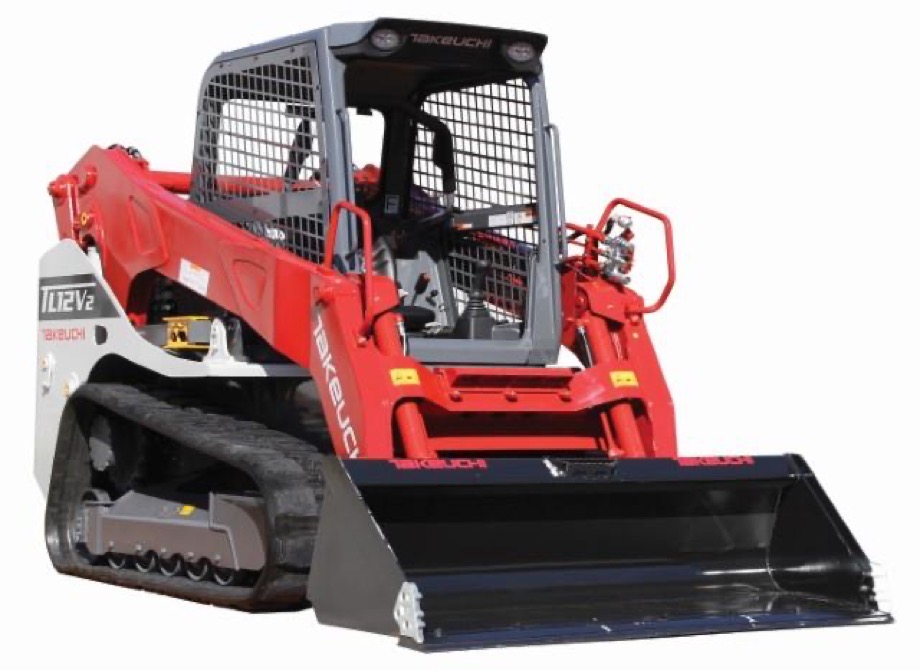
Takeuchi TL12V2
The bright segment is what Takeuchi TL12V2 is rated to carry; the grey run past it is the rest of its tipping load. Bar length is tipping load drawn to the same scale on every machine on the site, so a short bar is a smaller machine and not a conservative rating.
111 hp of Kubota diesel drives the Takeuchi TL12V2, a large-frame vertical-lift compact track loader. It's one of the highest-capacity CTLs available, prized for its lift performance, durability, and value from the CTL pioneer.
Suits: Maximum lift capacity and durability in a CTL, for heavy-duty crews Its vertical lift path reaches highest at full extension, for loading high-sided trucks and stacking.
Lifting and reach
- Rated operating capacityTrack loader rating convention
- 4,110 lbs
- Tipping load
- 11,740 lbs
- Lift height to hinge pin
- 129.9 in
- Lift path
- Vertical Lift
- Operating weight
- 13,195 lbs
Power and hydraulics
- Engine power
- 111 hp
- Engine
- Kubota V3800-TIEF4B
- Auxiliary flowStandard circuit
- 23.2 GPM
- Flow type
- Standard
- Warranty
- 2 yr / 2,000 hr
Fitted or available
What this machine can be ordered with. Some of these are standard and some cost extra, and which is which moves between trim levels, so check them against the quote rather than against this list.
What owners report
Summarised from the sources listed below. Nothing here was tested by us.
Load and carry is what this machine was built to do. Takeuchi's first vertical-lift track loader was, at launch, the largest vertical-lift machine in the industry, and the geometry change was worth roughly 45 percent more operating capacity than the radial TL12 it came from. Owners use it for truck loading, pallet and pipe handling, aggregate work and site prep, and they talk about it as a machine that out-muscles its price bracket rather than one that feels like a bargain.
The day-to-day experience splits cleanly into good hardware and a troublesome emissions system. The cab is genuinely well equipped as standard - pressurised, air conditioned, roll-up door, suspension seat, 5.7 in display with a rearview camera - and the undercarriage was lengthened with a contact pad between roller and track specifically for ride quality, riding on 17.7 in tracks at around 4.8 psi. Against that, the 111.3 hp Kubota carries both a particulate filter and a DEF tank, and owners report frequent DPF alarms, manual regenerations that will not complete, and shutdowns mid-burn that are awkward to recover from - made worse by a manual that will not let you force a regen the machine has not asked for, and by dealers who lean on the engine maker to diagnose it. Undercarriage is the other recurring cost, with tension checks wanted every shift and track life realistically somewhere between 800 and 2,000 hours depending on how abrasive your ground is.
Contractors whose daily work is moving heavy material up high are the target - loading trucks, feeding hoppers, setting pipe and pallets - and who can support a 13,000 lb machine on a trailer and in a yard. On price it generally undercuts a comparably specified Cat or Bobcat at the top of the class. Before signing, order the high-flow circuit if a mulcher is anywhere in your plans because it is not a retrofit, ask the dealer directly how they handle regeneration faults and how quickly, and if your work is really digging and prying rather than carrying, price the radial TL12R2 - it costs less and breaks out harder.
What owners like
- 4,110 lb of rated capacity is stated on the conservative 35 percent of tipping load basis that most of the industry uses, so it compares directly against a Bobcat, Cat, Deere or Kubota number with no conversion - and it is near the top of the class on that honest basis rather than a flattering one.
- The vertical arm was worth roughly 45 percent more operating capacity than the radial TL12 it was developed from, which is an unusually large gain for a geometry change and explains why load-and-carry crews moved to it.
- A 10 ft 10 in hinge pin and 8 ft 1 in dump height put material over the side of a tandem truck or into a hopper without first building a ramp of spoil to drive up.
- An 11,737 lb tipping load is what the capacity figure actually rests on, and it is what keeps the machine planted rather than light on the heels when craning a heavy load out at full height.
- 17.7 in tracks put roughly 4.8 psi on the ground under a machine of this weight, so it stays usable on soft ground where a wheeled loader of similar capacity would be parked.
- The cab is properly equipped as standard rather than as an option package - pressurised, with a roll-up door, air conditioning, heat, defrost, a wiper, a suspension seat and a 5.7 in colour display with a rearview camera.
- Full-load raise cycle is 4.0 seconds, which is brisk for a 13,000 lb machine and is the difference between keeping up with a truck and holding it up.
What owners complain about
- Breakout is the machine's soft spot. Lift arm breakout is 7,109 lb and bucket breakout 7,874 lb, and the cheaper radial TL12R2 beats it on both counts at 8,075 lb and 8,210 lb. The vertical geometry buys carrying and reach, and it pays for them in prying force.
- Owners report recurring trouble with the particulate filter: frequent DPF alarms, manual regeneration attempts that fail, and machines shutting down during an automatic burn cycle and then proving difficult to restart. The operator manual also restricts forcing a manual regen unless the machine has asked for one, which removes the obvious workaround.
- When those faults appear, dealers have been slow to resolve them because diagnosis leans on the engine manufacturer rather than sitting entirely with Takeuchi - so downtime is a support problem as much as a parts problem.
- The 40.4 gpm high-flow circuit that makes it a mulcher carrier is an option. Standard flow is 23.2 gpm at 3,481 psi, which is ordinary for the class, so a machine bought without the option cannot be upgraded into one later in any practical way.
- Undercarriage dominates the running cost. Takeuchi's own guidance is to check track tension at the start of every shift or every ten hours and to loosen it as packing conditions worsen, and the industry range it cites runs from roughly 800 to 1,200 hours in hard rental duty up to 1,600 to 2,000 hours for contractors doing earthwork only.
- At 12,865 lb bare and over 13,000 lb with a cab and a bucket it is a one-ton truck and a heavy trailer, and burning around 3.8 gal/hr at 65 percent load from a 32.7 gal tank means fuel is a real line item rather than a rounding error.
Drawn from takeuchi-us.com, kirby-smith.com, compactequip.com, skidsteerforum.com, certegmachinery.com.
What buyers ask
Is the 4,110 lb rating comparable to other brands?
How bad are the DPF and regeneration problems really?
Do I need the high-flow hydraulics?
How long do the tracks and undercarriage last?
Should I buy this or the radial TL12R2?
What truck and trailer do I need?
Put the Takeuchi TL12V2 against
Machines in the same range
The rest of the Takeuchi line
Takeuchi
Takeuchi TL11R3
$92,000
- Engine
- 107 hp
- Aux flow
- 23.1 GPM
- Weight
- 11,980 lbs
First of Takeuchi's new 3 Series track loaders, the TL11R3 is also the company's first with electric-over-hydraulic joystick controls. The 107.3 hp Kubota turbo-diesel drives a radial-lift boom rated at 2,735 lbs, with up to 40 GPM of high-flow auxiliary hydraulics for mulchers and planers. The EH system switches between ISO and H patterns, adds electronic self-leveling and adjustable sensitivity, and an 8-inch touchscreen with standard 270-degree rearview camera anchors a redesigned quiet cab. Takeuchi Fleet Management telematics comes standard for five years.
Full sheet & owner reports
Takeuchi
Takeuchi TL12R2
$88,000
- Engine
- 111 hp
- Aux flow
- 23.3 GPM
- Weight
- 12,590 lbs
Land clearing, forestry mulching, and hard digging are what the radial-lift version of Takeuchi's large-frame track loader is built for, rather than truck loading. The TL12R2's 111.3 hp Kubota V3800 turbo-diesel feeds an available 40.4 GPM high-flow circuit, bucket breakout tops 8,200 lbs, and the heavy 12,590 lb frame with Takeuchi's stout undercarriage keeps it planted on slopes. Where the vertical-lift TL12V2 chases lift capacity, the R2 trades reach at height for a simpler, stronger boom that attacks the ground.
Full sheet & owner reports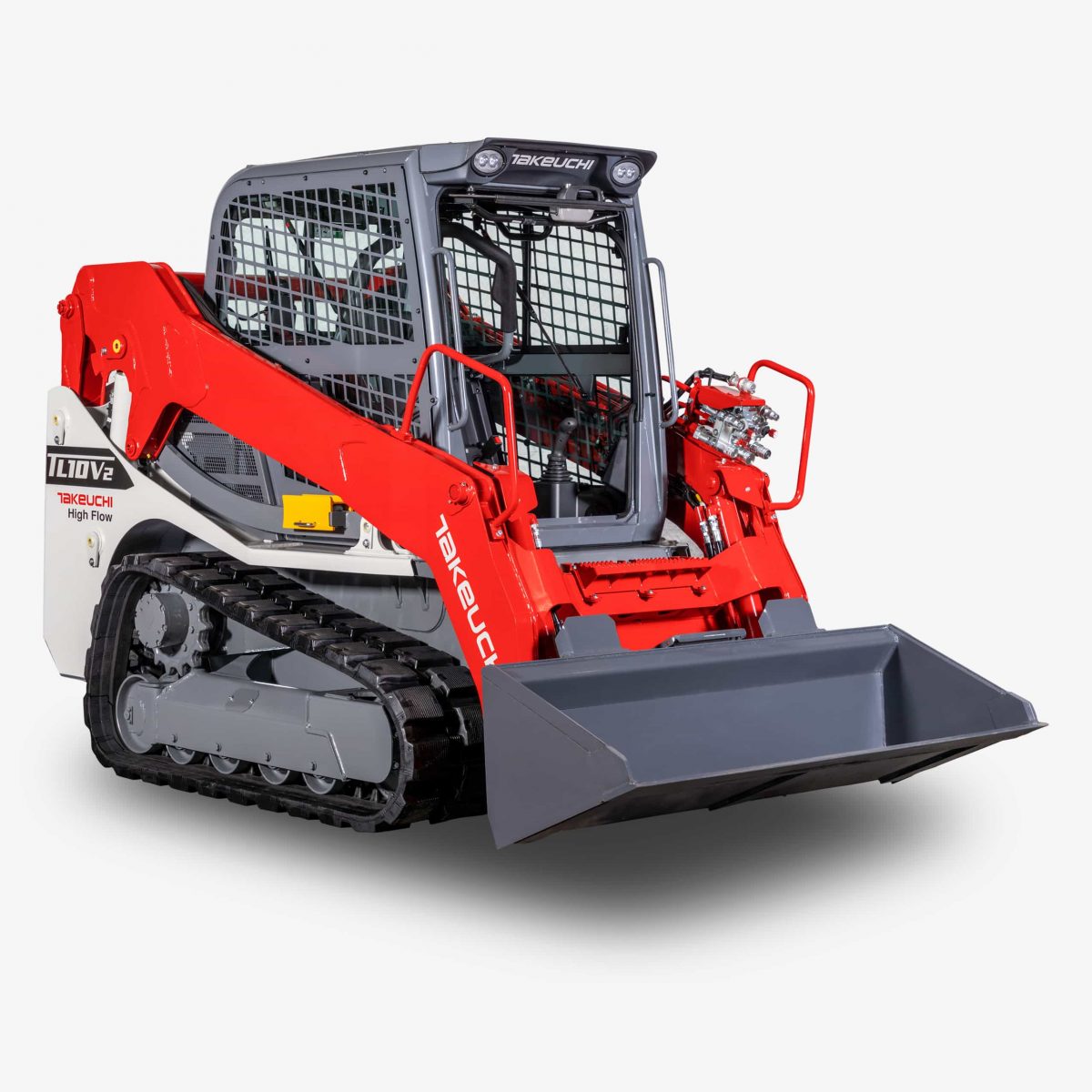
Takeuchi
Takeuchi TL10V2
$78,000
- Engine
- 74 hp
- Aux flow
- 18.8 GPM
- Weight
- 10,270 lbs
Built heavy at over 10,000 lbs with a 74.3 hp Kubota diesel, the Takeuchi TL10V2 is a mid-frame vertical-lift compact track loader from the company that invented the CTL. It sits between the TL8 and TL12V2 for contractors who prize Takeuchi's tank-like construction and undercarriage.
Full sheet & owner reports