John Deere
John Deere 333 P-Tier
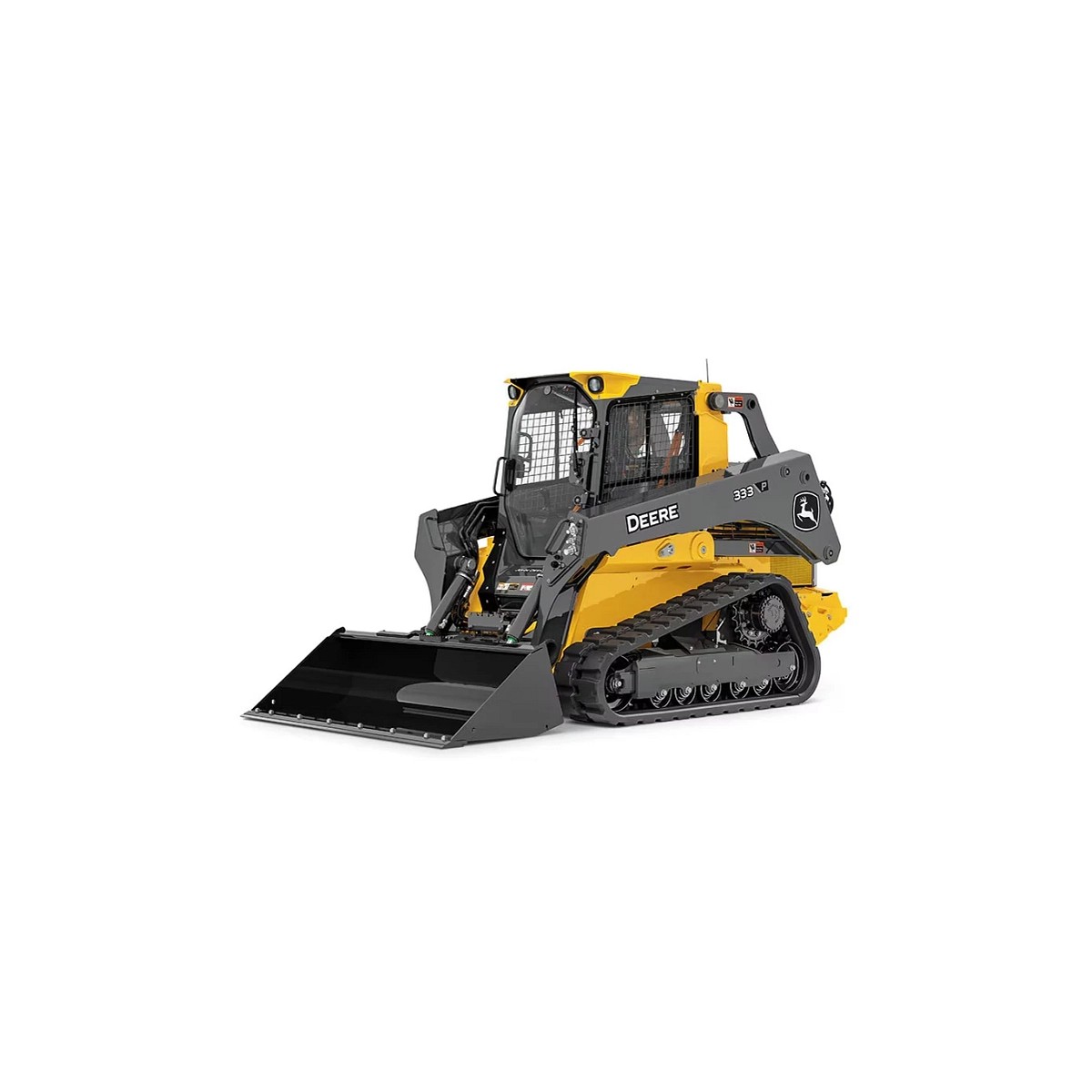
The bright segment is what John Deere 333 P-Tier is rated to carry; the grey run past it is the rest of its tipping load. Bar length is tipping load drawn to the same scale on every machine on the site, so a short bar is a smaller machine and not a conservative rating.
An 8% power bump to 108.5 hp, a 3,850 lb rated operating capacity against an 11,000 lb tipping load, and an optional 44 GPM high-flow system separate the 333 P-Tier from the popular 333G it replaced in mid-2024. It's also Deere's grade-control CTL - available SmartGrade Ready with 2D or full 3D SmartGrade with Topcon - wrapped in the new one-piece pressurized P-Tier cab with touchscreen display and EH controls.
Suits: Grading and site-prep contractors who want SmartGrade automation and high-flow attachment power in a proven large-frame CTL Its vertical lift path reaches highest at full extension, for loading high-sided trucks and stacking.
Lifting and reach
- Rated operating capacityTrack loader rating convention
- 3,850 lbs
- Tipping load
- 11,000 lbs
- Lift height to hinge pin
- 132 in
- Lift path
- Vertical Lift
- Operating weight
- 12,183 lbs
Power and hydraulics
- Engine power
- 108 hp
- Engine
- Yanmar 4TNV94FHT
- Auxiliary flowStandard circuit
- 25 GPM
- Flow type
- High-Flow
- Warranty
- 2 yr / 2,000 hr
Fitted or available
What this machine can be ordered with. Some of these are standard and some cost extra, and which is which moves between trim levels, so check them against the quote rather than against this list.
What owners report
Summarised from the sources listed below. Nothing here was tested by us.
Deere's grading and mulching machine, and the one model in the range where the option list changes what the machine fundamentally is. Rated at 3,850 lb on the 35 percent basis tracked loaders use, with 108.5 hp and an 11,000 lb tipping load, it is bought less for raw lift than for what the high-flow circuit and the factory grade control let it do. Owners of the 333G it replaces talk about it as two machines depending on how it was specified: a plain one that is simply a big track loader, and a SmartGrade high-flow one that replaces a small dozer and a dedicated mulcher.
The practical experience divides just as cleanly. Cooling and hydraulics are where this family has always been strong — the three-cooler layout and the reversible fan are what let owners run big heads on hot days. What breaks is less about iron than about emissions and electronics: the aftertreatment control unit generated the most persistent owner complaints on the outgoing machine, with codes appearing unpredictably past roughly 2,500 hours, and a documented case of joystick controller faults locking out the hydraulics entirely. Undercarriage remains the dominant hourly cost, the frame is rigid so ride trails Bobcat, and debris management is not optional — the predecessor had real fire incidents in mulching duty from material packing around the boom base.
This earns its price for a site-prep contractor who will actually use grade control, or a mulching outfit that needs the 44 GPM circuit and will maintain the cooling package religiously. For anyone else it is too much machine: at over 12,000 lb it needs serious transport, and a plain unit gives up most of what justifies the premium over a 331. Before signing, pull the full fault history rather than the active codes, function-test travel and hydraulics under load rather than in the yard, check lug height on the tracks, and get a straight answer on whether the aftertreatment control hardware differs from the G-Series. If you are buying it to mulch, price the reversible fan and suppression into the deal on day one.
What owners like
- Hydraulics are the whole argument for this machine: 25 GPM standard, rising to 44 GPM at 4,000 psi with the high-flow package. The outgoing 333G's 41.1 GPM already tied Kubota's SVL97-3 and beat Bobcat's T76 (36.6) and Cat's 289D3 (30.5), and owners running 70-to-75-inch mulching heads and large cold planers were the reason the option existed.
- Factory 3D grade control with Topcon is still something no rival offers from the factory on a track loader. It comes in tiers — full mastless 3D, SmartGrade Ready with slope control, or a laser slope receiver — so a buyer can take the part of it their work actually pays for instead of the whole system.
- The 11,000 lb tipping load and 12,183 lb operating weight make it settled rather than nervous at full extension, which is what loading tandems and feeding hoppers over a high sidewall actually demands.
- Cooling is a genuine class advantage carried over from the large-frame G-Series, whose three-cooler arrangement owners credited in hot-weather mulching and dust-heavy demolition. The optional reversible fan is the part that earns its money, because it lets you blow the core out instead of picking it clean.
- The one-piece sealed and pressurized cab replaced a two-piece design and added about 20 percent more sightline, with an 8-inch touchscreen and an optional 270-degree camera view. Operators who spent years in the G-Series cab treat this as the real generational change, more than any spec on the sheet.
- Attachment Manager pre-programs flow and pressure for recognised Deere attachments, which matters most to the owner who is not the only person running the machine — it stops a $20,000 mulching head being fed the wrong settings by whoever climbed in that morning.
What owners complain about
- The emissions control unit was the single most-documented complaint on the machine this replaces. Owners logged recurring DCU fault codes that surfaced with no pattern — ran fine Monday, coded Wednesday — most often past 2,500 hours, alongside ECU codes in the same family. Ask a dealer specifically what changed in the P-Tier aftertreatment rather than assuming a new model number fixed it.
- Heavy forestry mulching produced documented fire incidents on the outgoing machine, traced to debris packing around the boom base and in the belly where the arm geometry forms a cup. Anyone buying this for mulching should treat the reversible fan, an aggressive daily cleanout and aftermarket suppression as part of the purchase price, not accessories.
- At 12,183 lb before an attachment it is past what a 3/4-ton truck and a light trailer can legally move — the 12,100 lb predecessor was already over that line. Budget for heavier transport as part of the buying decision.
- There is no torsion suspension, and the rigid roller frame is the reason Bobcat still wins comparisons on pure ride smoothness. On rough ground at travel speed you feel more of it, and material leaves the bucket sooner.
- Grade control is expensive enough to change what you are shopping against — on the predecessor the SmartGrade premium ran CAD $40,000 to $80,000 over an equivalent plain machine. A fully graded unit lands in territory where a small dozer starts to look like the honest tool.
- Owners of the outgoing machine damaged cab doors by raising the loader arms with the door not fully latched, common enough that Deere sold a severe-duty door to address it. It is a habit problem, but it is a habit that costs glass.
- Takeuchi's TL12V2 brings more engine (113.5 hp) and slightly more rated capacity (3,860 lb) for buyers who do not need the hydraulic ceiling, though it gives up a great deal of high flow at 32 GPM. Worth a look if your attachments are undemanding and your priority is push.
Drawn from aglist.ca, fortishd.com, compactequip.com, government-fleet.com.
What buyers ask
Is the high-flow package worth it, or is standard flow enough?
How does it compare to the 331 P-Tier, and is the step up worth the money?
What should I check before buying a used one?
Can I tow it with a 3/4-ton pickup?
Is it a good mulching machine?
How long do the tracks and undercarriage last?
Put the John Deere 333 P-Tier against
Machines in the same range
The rest of the John Deere line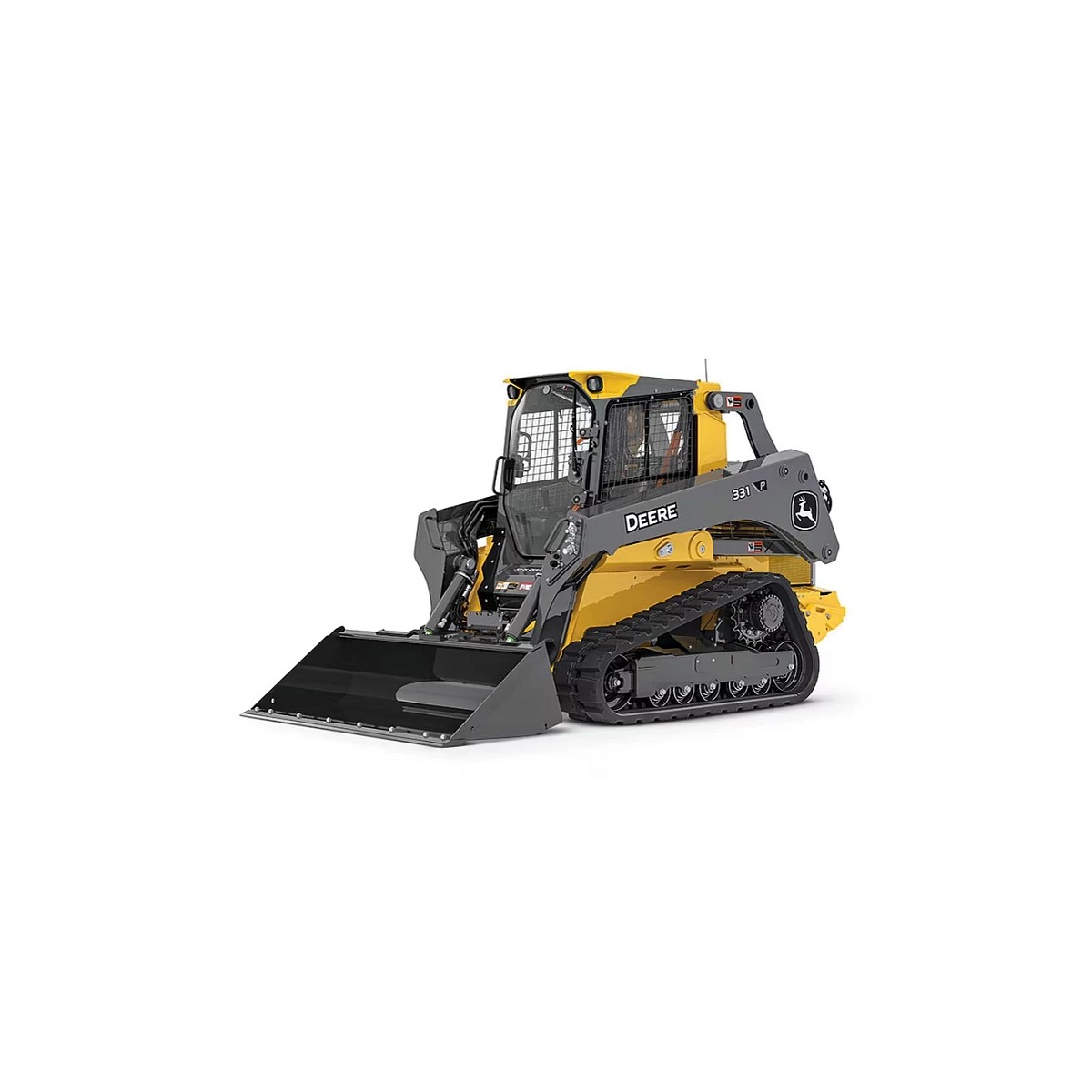
John Deere
John Deere 331 P-Tier
$94,809
- Engine
- 98 hp
- Aux flow
- 25 GPM
- Weight
- 11,914 lbs
Deere's new CTL lineup has its volume workhorse in the 331 P-Tier, the large-frame machine that replaced the 331G in mid-2024. It pairs a 98 hp turbo Yanmar with a 3,150 lb rated operating capacity (35% of a 9,000 lb tipping load) and Deere's patented vertical-lift boom, then adds a one-piece pressurized cab, EH joystick controls, 132-inch hinge pin height, and optional 39 GPM high-flow hydraulics.
Full sheet & owner reports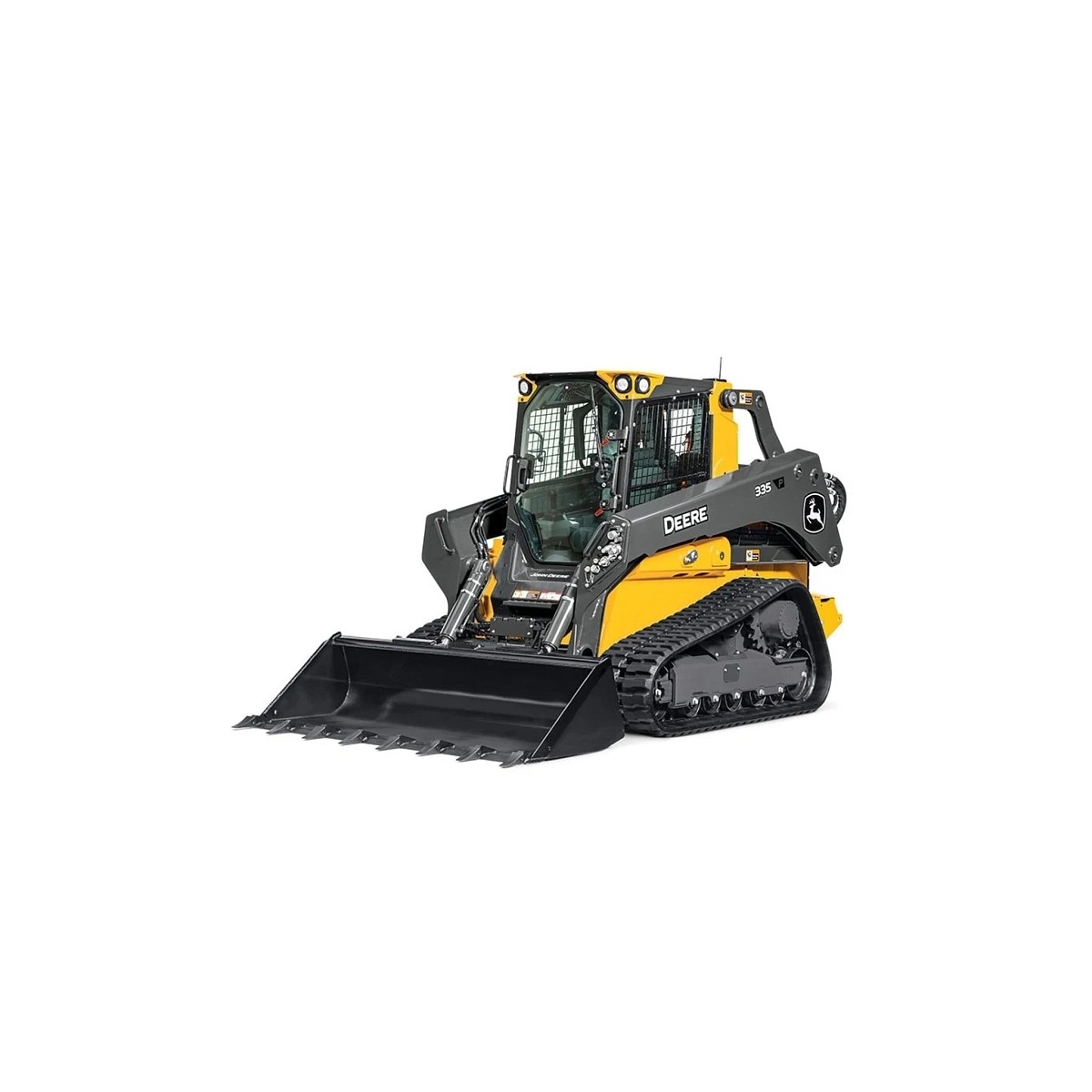
John Deere
John Deere 335 P-Tier
$143,639
- Engine
- 118 hp
- Aux flow
- 25 GPM
- Weight
- 12,300 lbs
With no G-Series predecessor behind it, the 335 P-Tier arrives as the new flagship of Deere's compact track loader line, built around a 118 hp turbo Yanmar, a 4,025 lb rated operating capacity against an 11,500 lb tipping load, and an optional 44 GPM high-flow system delivering over 100 hydraulic horsepower. Standard Attachment Manager, available SmartGrade with Topcon, and an optional SG96 dozer blade position it as a do-everything production machine at the top of the class.
Full sheet & owner reports
John Deere
John Deere 325 P-Tier
$76,000
- Engine
- 74 hp
- Aux flow
- 21 GPM
- Weight
- 9,500 lbs
The 325G was Deere's best-selling mid-frame compact track loader, and the 325 P-Tier replaced it while keeping the 74 hp DEF-free Yanmar and 2,590 lb rated capacity, adding a roomier sealed cab, standard EH ISO joysticks, and optional high-flow hydraulics. It stays under the 75 hp Tier 4 threshold that avoids DEF, and the vertical lift path with a 10.5-foot hinge pin height loads tandem dump trucks cleanly - the all-around configuration that made the 325G a landscaper and rental favorite.
Full sheet & owner reports